The Desire for Images at Base Native ISO, Camera on Tripod
All of the images you’ll see in this post were shot at the base native ISO of my Nikon D850—64. This one presented the difficulty of making contrast work.
Why is It so Desirable?
My Nikon D850 has a base native ISO of 64, and because of a second read circuit in its sensor, it has a second native ISO of 400. To put it simply—as I’m hardly technical enough to explain a DSLR sensor in great detail—this (expensive) state of affairs helps allow for the reduction of noise at high ISO levels affecting the quality of images, which the Nikon D850 full frame camera is famous for. At ISO 400, it’s less likely you’ll need a tripod, but using a tripod with the camera set at ISO 64 may add to the substance of the experience of shooting itself.
Besides the Nikon D6, which came out in 2020, the company hasn’t produced another DSLR after the D850 in 2017, having pivoted towards mirrorless cameras. I can’t speak to mirrorless cameras, having no experience with them and knowing little about them, but my Nikon D7100 crop camera has a base native ISO of 100, which is plenty low. And yet, I love the fact that my full frame D850’s is 64.
How especially low ISO affects the quality of an image at that setting, I’m not deeply informed about, but the images produced are of substantially good quality. Of course, base native ISO means noise won’t develop in the image; it’s the technical details about why that is I won’t go into. I remember using ASA 64, 35mm film during the 1970’s. (The former American Standards Association designation for film.) Because of my familiarity, the ISO number of 64 brings me back to the past a little, an associative element in the psychology of the creative process that can’t hurt.
In general, I find I positively desire using my carbon tripod and getting shots with the best dynamic range possible—at that base native ISO of 64.
But I have never felt tempted to shoot at the “Lo” setting, which is not a true ISO setting (of 32), which I have read described as a “digital push" that can compromise highlights.
Many times, when I did outdoor photography at Round Valley Recreation Area, wind prohibited the use of the tripod, because shutter speeds would have been too slow. Almost invariably, I came late in the day when the sun began to set, and in some situations the sun got behind the trees. Whether sunlight remained abundant or the light got low, shooting at ISO 64 made me feel as if I could capture perfection.
And feeling has a lot to do with how any of us will perform. Positive feeling will not only motivate you to get involved; it will help attune your senses to the environment in which you seek out images. If you like the base native ISO of your camera, and can reasonably exercise the setting, not too much of a breeze present, why not? The desire isn’t an illusion. Base native does mean, after all, that the sensor isn’t creating any noise.
Shot at ISO 64 in low light, I nevertheless failed to capture blue in the sky. So I “replaced” the sky in Photoshop. I know little of how post-processing works, but you can tell that sky isn’t quite right. I think it’s better than that off-white, greyness that gives away that you overexposed it, though. Maybe it “works.”
ISO as Gain
A DSLR sensor works in part by responding to the ISO selection you either make manually or allow the camera to choose for you. For example, I habitually use Manual Mode, which means I select the aperture and the shutter speed. (I keep focus automatic.) The camera configures my selections against the light it senses…selecting the ISO. Not when I select ISO 64, however.
The subject in the distance, and thankfully not moving much, I managed to freeze the frame at ISO 64.
If I’ve set my camera up on my tripod and have manually selected ISO 64, I’ve chosen Aperture Priority as the mode, and the camera selects the shutter speed, which is usually a third of a second. (Too slow, in situations where vegetation moves in the foreground—if the breeze is considerable.)
Even with few strands of vegetation to sway in a breeze, you may need to bump up the shutter speed. I got this shot, however, in relative calm, perhaps when the breeze paused. Since you can see ripples on the reservoir water in the background, some air movement did exist.
This pile of rocks, however, presents nothing to move in a breeze. So if you take the time and patience to look around, you might find opportunity for your tripod even on a windy day.
So long as my black Lab Sadie didn’t move, I was OK with this shot, though if wind had persisted, the phragmites to the right would have blurred. That said, notice the dead grass between the wood in the foreground. It’s not in good focus, belying the opportunity to have focus-stacked, a subject I will turn to perhaps in my next post.
If my Manual Mode configuration results in a high ISO setting, it gets tricky. If I get a shot at ISO 3200 and find I need to crop out 75% of the image, I’ll probably want to use denoise AI in Lightroom. To crop an image is to reduce its pixels and make it more susceptible to noise. Postprocessing sliders, like adding brightness to an image, will raise noise, also. I might postprocess by using denoise AI to clean up a shot at ISO 6400, and such ISO figures crop up commonly when shooting by hand.
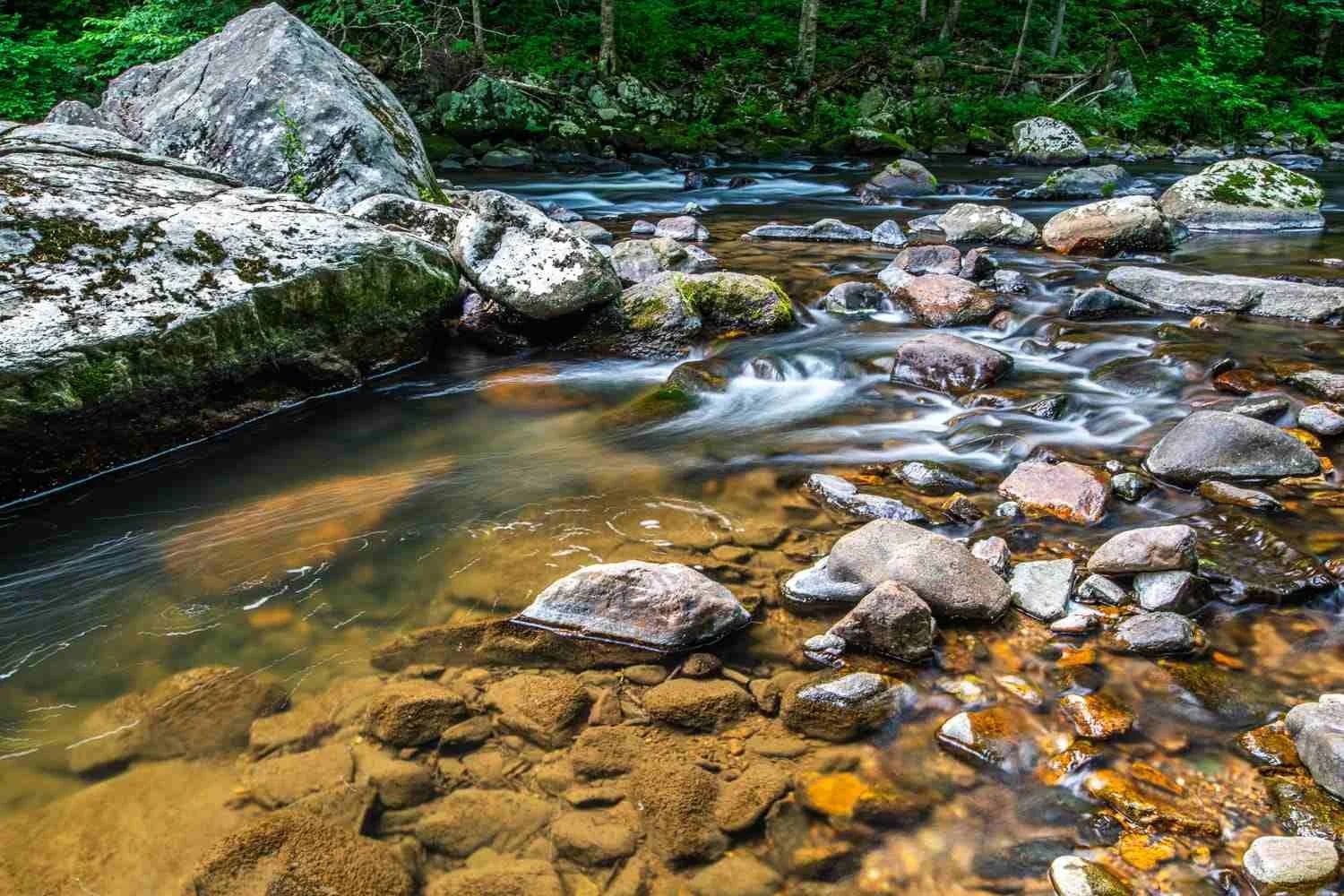
South Branch Raritan River’s Ken Lockwood Gorge, shot at ISO 64 and a slow shutter speed to get the silky current effect.
That said, the Nikon D850 doesn’t show a whole lot of grain at ISO 6400, and even at 25600, I have finished products I’ve postprocessed using denoise AI that are clean and sharp.
Shot with a 70-200mm zoom at 78mm. the scene hints at drama. In the way the light illumines greenery as carefully plucked detail, against a sky with just a slight quality of forboding. Rocks and greenery seem to dance together rather than merely to “sit” there. Beware of how things sit. The throne is all too much a symbol of our Western Civilization. Everything shifts out of place.
As You Like It
It’s not as if ISO 64 is the only setting I want to shoot at. It’s just a specialty, but specialties of all forms are what makes up personality. Photography is nothing if not personal. Desire comes before the conscious personality plays it out; it has a mysterious quality, pulls us “out of ourselves” so we go out to meet something distant in the world. Something that beckons us forward.
Distant from us. When we get there, something magical transpires.
And rather than denigrate magic as if it’s unreal, any of us knows we value things in ways that don’t conform to the absolute measure of objectivity. As if otherwise the world has no play. As if it’s all exactly what it is, with no allowance for creativity.
To think that such objectivity exists without us is misleading, because measurement without someone doing the measuring…makes no sense.
The golden light of sunset at Round Valley brings out the color of the iron in rocks, gravel, and soil. Another tripod photo that allowed for a breeze.
Be Patient with the Breeze
It’s not necessarily true that a breeze means you can’t use a tripod and shoot at a relatively slow shutter speed. I’ve shown you three photos wherein the breeze didn’t affect quality.
Before you buy a tripod, if you haven’t bought one already, be prepared to pay a fair sum, if your product research points in that direction. You should make sure to buy one that will hold your camera stably.
The $375.00 I spent in 2014 for a carbon Manfrotto tripod has proved to be worth it. It’s had loads of use, and remains as good as new. I marvel at its clips not having broken off, the ones I loosen to extend the legs and press into place to keep them extended.
Another thing to keep in mind is that a breeze often slows and pauses, allowing you to get a shot with vegetation in the foreground. I’ve managed to click the cable release on multiple occasions when wind has paused. And yes, do use a cable release so no motion is imparted to the camera when you click that shutter. They’re very inexpensive. And when you use a long lens that has vibration reduction, make sure that vibration reduction is turned off when you use the tripod. It’s only an asset when the camera is held by hand and might impart a little motion. I even wonder what happens if your hand hold is perfectly stable, except that hands are supple and allow for motion on them.
Exercising patience is desirable in itself, as it involves you all the deeper in the process, not only of your photography, but of being outdoors. Being outdoors, after all, is what is so compelling about outdoor photography. And the more attuned you become to your surroundings, rather than only being there as if you’re motionless with regard to what you see and are, the better shots you’ll compose.