Lake Hopatcong Ice Fishing for Multiple Species
The writer with a nice sized pickerel caught in six feet of water near Lake Hopatcong’s River Styx.
Shallow and Deep
The article was published originally in New Jersey Federated Sportsmen’s News of the New Jersey Federation of Sportsmen’s Clubs.
Lake Hopatcong is widely regarded as New Jersey’s best ice fishing lake. Situated nearly a thousand feet above sea level in Morris and Sussex counties, it’s one of the first places in the state to freeze and one of the last to thaw. Multiple species thrive here. Residual weeds produce pickerel, yellow perch, panfish, largemouth bass, crappie, while deep drop-offs hold walleye, musky, hybrid stripers, and even smallmouth bass and crappie get caught on them.
Joe Landolfi with a big tiger musky from Lake Hopatcong’s Chestnut Point Area. It hit in 20 feet of water.
Muskies
If you decide to go for the big ones in deep water, be patient, because the catch rate is considerably slower than what you’ll experience when fishing weedbeds. Muskies weighing more than 30 pounds come through the ice, and I once encountered a couple of anglers targeting them with live suckers. (I wasn’t clear on whether they used heavy-duty tip-ups.) If you clip a sucker’s tail fin, it will wiggle but be unable to swim, so it won’t trip a tightly set tip-up flag.
Live trout are another option for musky bait, and they can be purchased by appointment at the Musky Trout Hatchery in Asbury. So long as you have the receipt, any size trout can be used for bait as you would use a sucker. But because live shiners are most often used, they seem to catch most of the muskies. They work for the other deep-water species as well. You might be able to buy extra-large shiners, if you contact various bait shops.
A friend of my son, Will, has gathered a shiner from the bait bucket, using a scoop.
My son, Matt, checks on a tip-up. In this case, the line angles because it’s caught on skim ice in the hole, not because a fish is pulling it in the direction it's leaning.
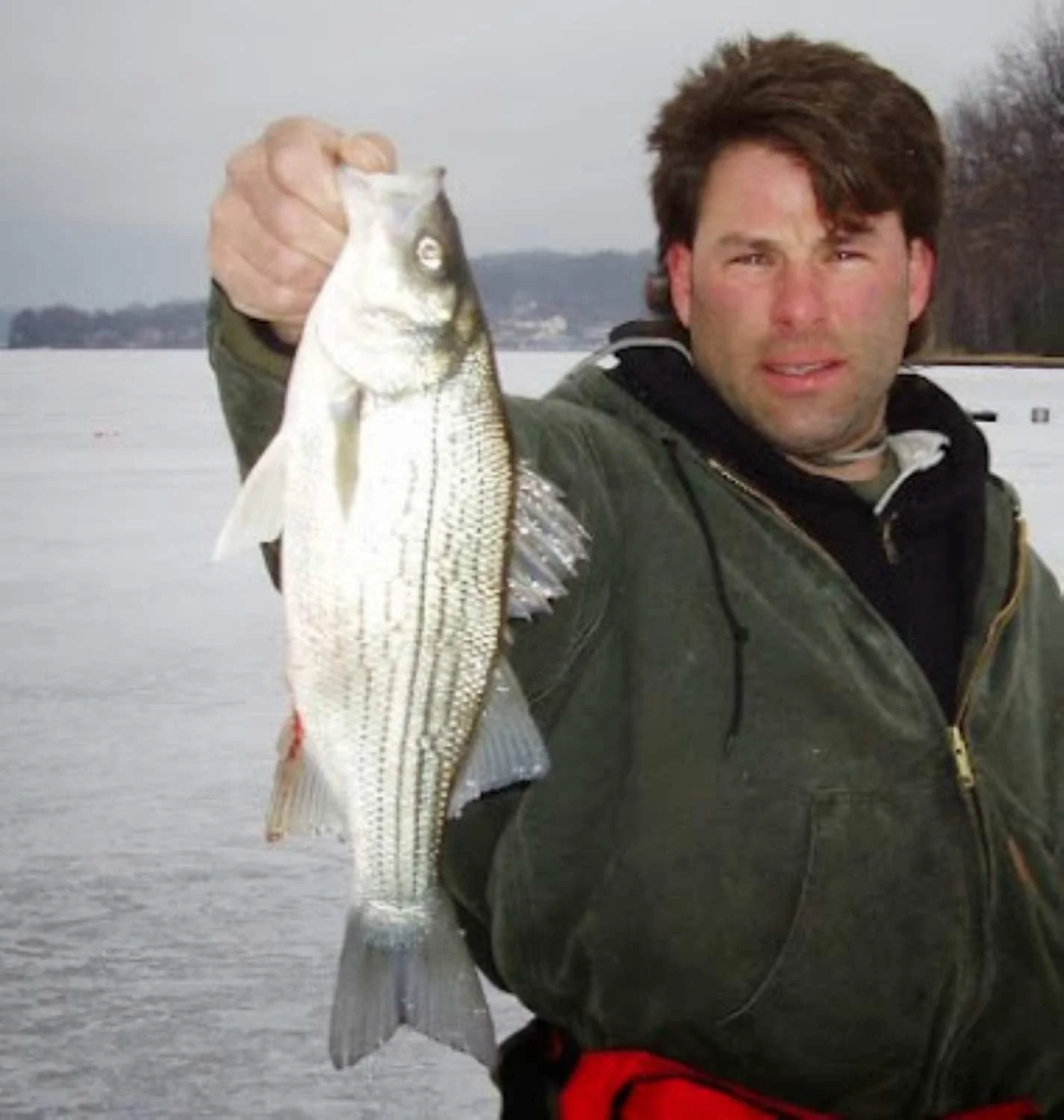
Joe Landolfi with a hybrid striped bass, a denizen of deep drop-offs that will take shiners. Hybrids are also available at Spruce Run Reservoir, Manasquan Reservoir, and some private lakes like Culver and Mohawk, but no lake may be better for them than Hopatcong.
Pickerel notoriously devour shiners. This one, caught by Joe Landolfi, was photographed inside the shop of Dow’s Boat Rentals many years ago.
Live Shiners for Bait
Live herring are not available at tackle shops during the winter, so unless you net, pot, or use hook and line to catch other species like suckers and chubs, you will use live shiners at a slight disadvantage compared to how live herring would perform, since the deep-water forage for walleye, hybrid stripers, smallmouth bass, and muskies is chiefly herring. Whatever else the muskies feed on—surely including small carp and yellow perch, although carp are not very common—they eat herring, too. Walleye are a more popular pursuit than hybrid stripers or smallmouth bass, and many anglers use Rapala Ice Jigs to catch walleye.
If you plan on jigging but you’re unfamiliar with the lake, study a topographic map and correlate what you learn to a chosen access point. I will discuss access later in the article. Spots like Nolan’s Point, Chestnut Point, the Ledge, Racoon Island, Cow Tongue Point, Sunrise Point, Elba Point, Pickerel Point, Sharp’s Rock, the hump in front of the yacht club, and less prominent spots all have steep drops where the deep-water species hang anywhere from 20 to 50 feet down, although not every drop-off descends to 50 feet. Again, study a map if you want to bet on the lake’s deepest water (50 feet or so).
Thick, late season ice. Joe Landolfi reaches deep into the hole to estimate that thickness. At one point, he walked right to the edge of the open water, where he found, if I remember correctly, the ice was eight inches thick, most of that thickness hard and clear, not the white near the surface that isn’t strong. He had learned about thick edges from way back. I had no idea.
Oliver Round baiting up at Lake Hopatcong early in the season before any snow got on the seven inches of “black” ice.
My son’s friend, Will, cuts 26 inches of ice late in the same season I fished earlier with Oliver Round at Lake Hopatcong.
Muskies sometimes get caught 20 feet deep or even shallower, as do smallmouth bass, although walleye and hybrid stripers usually strike considerably deeper. Sometimes the fish are suspended, but typically the jigging is done at bottom. You’ll probably need an auger to cut many holes and cover range with a jigging rod. If you’re young and exceptionally strong, you can bust holes with a splitting bar, but if you need me to tell you so, I suggest you find someone who knows ice fishing to serve as guide for a few outings. Younger guys might otherwise want to go with hand-driven auger varieties, but the new lithium battery models work in a jiffy, as do the old gas-powered versions.
Nowadays, some ice anglers have video equipment that shows fish interested in their lure or bait. I have seen a few videos of fish that didn’t hit but were attracted to jigs. They confirm my notion that more is involved in teasing a fish to hit than working a jig mechanically. Granted, some fish will eventually hit a jig slowly lifted up and down without compelling rhythm. And unless you use such video equipment where there’s enough light, or you use a sensitive fish finder that shows a fish taking interest, you’re never going to know if a fish is near your offering until that fish hits. But you can involve yourself at jigging as if to tempt a take. Avoid jigging fast, because the fish are slowed down.
Once the lake freezes thick enough—if it does—some ice fishermen range the miles in snowmobiles, setting up so it’s convenient to go elsewhere at short notice. When frozen, Lake Hopatcong is an exciting social event, and snowmobiles give users the special advantage of being able to survey what’s going on throughout the lake’s nine-mile length.
Joe Landolfi with a nice pickerel from relatively shallow water.
Relatively few ice fishermen use snowmobiles, however. Most walk out from access points knowing nothing of what’s going on elsewhere. If you buy bait at Dow’s Boat Rentals, you can park in the lot above the shop and access the ice from the wooden steps. We can only hope that Dow’s remains in business a little longer, as Laurie and Joe are soon retiring. Wish them well, because the many decades of glory fishing the lake until the present as I write have been accompanied by them.
Nolan’s Point and shallows nearby, Great Cove depths and shallows, and Chestnut Point are all yours, if you can access them from those steps I mentioned. You can hike anywhere you please if the ice is thick. The State Park allows access to a very large shallow flat in front of the beach, which is a popular spot for pickerel, perch, and panfish. It reminds me of Lake Musconetcong. You may also be able to get on the lake at River Styx for the same species, as well as Woodport.
During my teens, I felt inspired by what I heard about the lake as the state’s best ice fishing, and I drove up from Mercer County one frigid January day when temperatures never rose above 15, wind howling. Ice was at least a foot thick, and yet I cut enough holes with a splitting bar for 15 tip-ups among three of us. I can’t remember how and where we found access without maps. No intel. Nothing. With all of the information available today, you should be able to come up with a plan before you go.
In March 2001, Joe Landolfi led the way. We accessed a large, very shallow flat. So shallow I didn’t have to release more than a foot of the braid from tip-ups, but we caught pickerel. Joe also located a school of bluegills and perch, jigging about a dozen of them while using tiny ice jigs tipped with live mousy grubs. “Shallow” can mean three feet of water, but it can also mean 16-foot depths where Lake Hopatcong’s deepest weeds have grown. I don’t remember where we got on the lake that day, but the access point was none of those I’ve noted.
Oliver Round probably had a shiner in his right hand, as he took a tip-up to set it up on the edge between shallows four to six feet deep, and depths as great as 40. It looks like open water, but it’s clear, hard ice. We fished the drop down to 10 or 12 feet. On one occasion two or three years previous, my son had something big on a shiner under a tip-up set over bottom 10 feet down on that drop. The fish got off, but we’ve never forgotten.
As I’ve indicated, very shallow water holds fish under the ice. Shallow coves are the first to freeze and become safe, during a time when ice seasons become increasingly unlikely. The winter of 2018-2019, I never got out, and if I’m not mistaken, a handful of guys enjoyed only a few days when ice thickened to marginal safety over cove shallows. Joe Welsh at Dow’s Boat Rentals told me he’s seen business erode over the course of recent decades for one reason—diminished ice. Anyone can glance at a global temperature graph online to see the climate is getting warmer, and from the vantage of Lake Hopatcong, Joe Welsh’s observations are probably more informed than anyone else’s. He’s spent hours daily on the water for decades. Opportunities to ice fish Lake Hopatcong will likely become fewer over the years ahead.
That’s something to remember when you’ve set tip-ups over weedbeds to catch pickerel and bass, while you jig yellow perch and panfish, or after you have wrestled a musky. (You won’t think of it during the fight!) Savor the ice while it lasts, take photographs for future generations to marvel at. The history of ice fishing on the lake does continue to develop, and if I’m correct, the Lake Hopatcong Historical Museum, located at Lake Hopatcong State Park, well documents it. I remember viewing a photograph that displays a pickerel caught through the ice during the 19th century.
Remember, too, that for whatever reason, pickerel aren’t originally native to the lake. They are to the state of New Jersey, but in the beginning, Lake Hopatcong had yellow perch, bullheads, and sunfish. That’s about all. Largemouths and smallmouths aren’t native to New Jersey, and according to Marty Kane at Lake Hopatcong History Museum, pickerel got stocked early in the 1800’s. It’s always astonished me how well pickerel do in the lake, even though they weren’t there in the beginning.