Brian Cronk and a nice one from before when the law about life preservers changed … just as non-bulky CO2 versions hit the market. Very conveniently. Going to have to buy one of those.
Beginning with November
November is an outstanding month to fish for chain pickerel.
Decades ago, a friend, Joe Kasper,, and I would begin catching “pike,” as we named chain pickerel, in the Delaware and Raritan Canal during October, and then in November from a 15-acre pond we called Tree Stumps. The pond was a field of stumps except for a large creek channel holding big pickerel along the edges. We never fished the chains in the open water of mid-winter and on into early April as I would later in life, but we did pretty well at them, as it was.
The pond was owned by a farm near Plainsboro in Middlesex County. Pickerel grew to 28 inches and probably bigger by gorging on abundant silver shiners. Kasper caught them as big as 28 inches, so who knows how big they actually got. After developers bought the property, the water chemistry changed. It annihilated the burgeoning population of shiners, and the pickerel disappeared overnight as if they would forever be ghosts.
After that heartbreaking loss, I started fishing the canal on through the winter so long as it remained free of ice. Friends and I caught pickerel as large as 20 inches on crappie jigs.
My son, Matt, wearing his Shannon’s Fly Shop cap, which he bought when it was still named that, and not South Branch Outfitter/s.
Mid-Winter and also a Late November Excursion
I maintained a loose connection to the canal during the month of March for a few years around the time I got married in 1997, two decades after the October forays I had mentioned. My wife and I soon had a son. By the time he was four, he wanted to fish on several occasions every week. He was six or seven when he made a big deal about wanting to catch pickerel, so I began taking him to a pond in Morristown.
Mild days in January suited us best. His first pickerel was a little 16-incher, but he soon caught plenty as big as 20 inches.
I fished a deepwater lake with him on November 28, 2020. From our family residence in Bedminster, he had returned to his apartment in Boston during September despite the pandemic, but he revisited his mother and I for Thanksgiving and a while thereafter. We fished live shiners among the residual weeks of the lake’s clear water, though I knew jigs would do the job.
The canal had abundantly proved the effectiveness of jigs during January and February. Spinners work too, but I like using live shiners in the cold water. Matt followed suit. On that day, the 49-degree water temperature was really on the mild side for an afternoon that late in the month. But it was cold enough to make fishing live shiners appealing. Impaling a shiner between the lips with size 6 plain shank hook, adding no more weight than single barrel swivels between 15-pound-test braid and 15-pound-test fluorocarbon leader, I ended up hooking a pickerel I estimated at 19 inches in 10 or 12 feet of weedy water, the fish barely getting away as Matt slipped the net underneath.
Later during our excursion, we maneuvered around a shoreline across the lake, Matt set the hook too soon, reeling back a decapitated shiner. I had made the same mistake when another pickerel took my offering a half hour earlier.
They hit a shiner in the middle, then turn it around so it goes head first towards the gullet. Let a pickerel finish an initial run, and then tighten up just enough to feel it work that shiner head-wise. You’ll feel a heavier tug when the pickerel takes the fish whole towards the gullet. Set the hook! You don’t want to gut-hook the fish, but you don’t want to lose it! You’ll know when. But you’ll you when it’s too late, also, and that feels sickening.
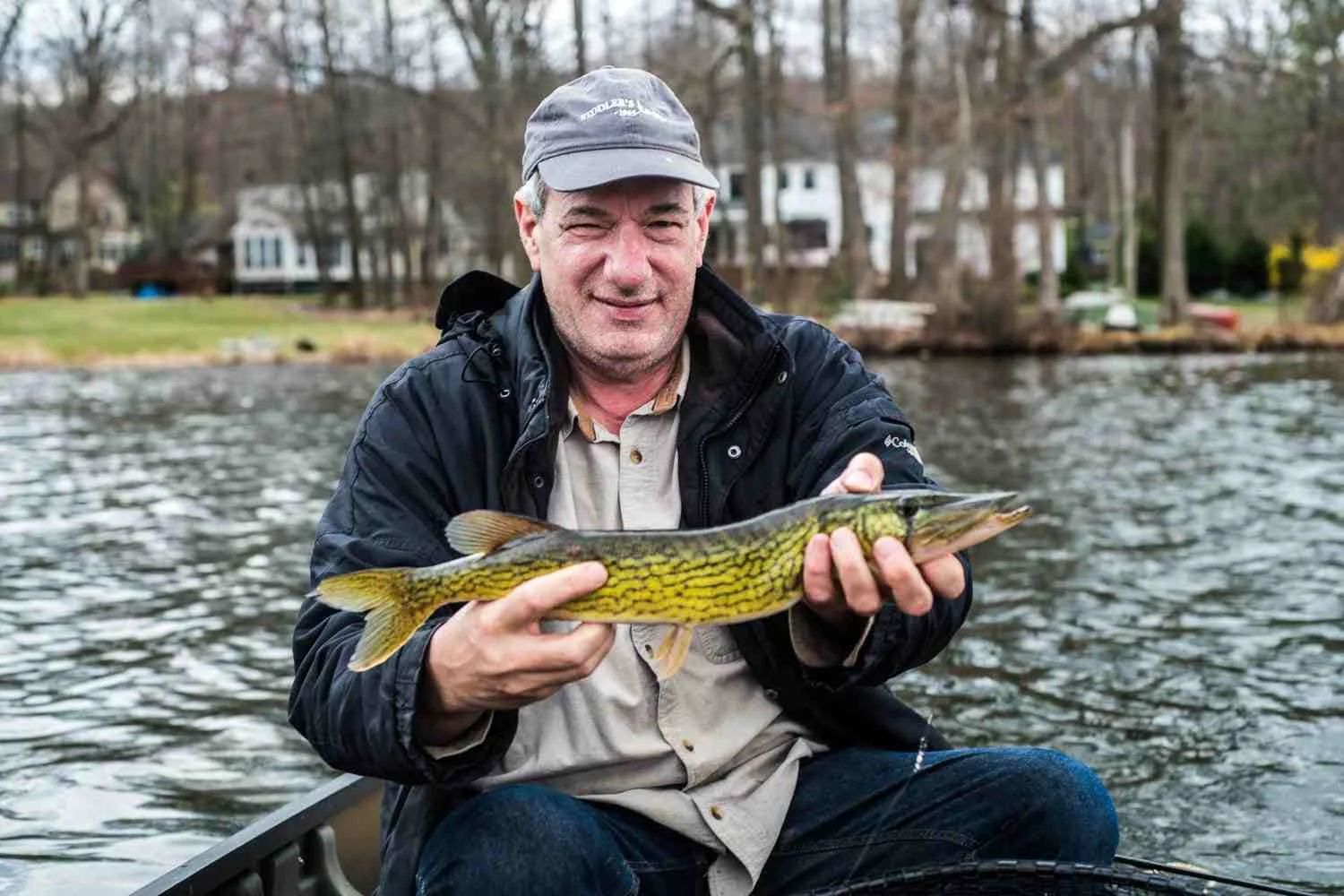
Not a bad one, caught in April on a shiner.
Early April, too
I know about opportunities for pickerel more than I’ve had time to go out and pursue them in recent years. I have enjoyed a few early Aprils on a private lake when water temps got into the low to mid-50’s. At least on one of the occasions we used live shiners effectively, but my son showed my friend Brian Cronk and I that we could catch even more fish on spinners. The water having warmed into the 50’s allowed us to fish a lot faster than the slow, persistent, patient pace I enjoy when the water is especially cold.
Besides what I do know, I’ve seen more on Facebook than I could have imagined, though it leaves me to wonder blankly where. Facebook is legion in the refusal to reveal spots, but you can see results and see amazing action on video, such as pickerel after pickerel hitting plugs at the surface in November, leaving you to a lot of questions.
Regardless of the amazing action some anglers enjoy on certain private waters, there are hundreds of public lakes, ponds, canals, rivers, and reservoirs throughout New Jersey offering good pickerel fishing from November into April. Along with yellow perch, brook trout, and the elusive bowfin, pickerel are native New Jersey freshwater gamefish, although they’re not original to every natural body of water where they’re found. They were introduced into Hopatcong, for example.
Most winters amount to at least three weeks of ice fishing in North Jersey—sometimes more, sometimes less—but open water means pickerel can be caught. Most lakes holding them—like Wawayanda, Aeroflex, Hopatcong—have plenty of residual weed habitat. Ponds like Turn Mill in the Pinelands, Weston’s Mill near New Brunswick, and the two Burnham ponds have some too. You can use a hook with a weed guard, but I don’t recommend that, because it just amounts to more hardware to get in the way. I’ve never tried one, though, so don’t grant me the status of expert on weedless hooks. And I expect a little size 6 hook to get stuck. I’m not putting the shiner where it needs to go, if I don’t occasionally drag some green.
Not necessarily does wood produce, since weeds might be abundant and pickerel relying on them. On this rough outing—rollers coming across Lake Hopatcong and wind-driven rain pelting Oliver Round and I—Oliver caught one on a fairly deep edge of weeds.
Wood in the Water
But weeds aren’t the only habitat. The canal exemplifies wood in the water, where all the cold-water pickerel I catch associate with that, with woody cover. Some residual weeds do last through winter, but a lot of deadfalls get into the water along the bank, and pickerel—being long, thin, brownish fish—camouflage perfectly by holding motionlessly besides branches. Pitch or cast a jig and retrieve it while jerking the rod tip … right along brush and branches. Pickerel strike like lightening. So suddenly I never could see exactly where from.
Wherever you find woody cover mixing with and breaking the usual pattern of weedy habitat, make sure to fish that cover carefully. You should always fish thoroughly, but most lakes holding pickerel will have more weeds than you can probably fish all year. Look for woody cover as spots not to pass up. They will be much fewer than most spots amounting to weeds and water as deep as 25 feet. Spots not to forget so you can return to them on future outings.
My article originally appeared in New Jersey Federated Sportsmen’s News.