Catching the Big One…and Knowing Its Size
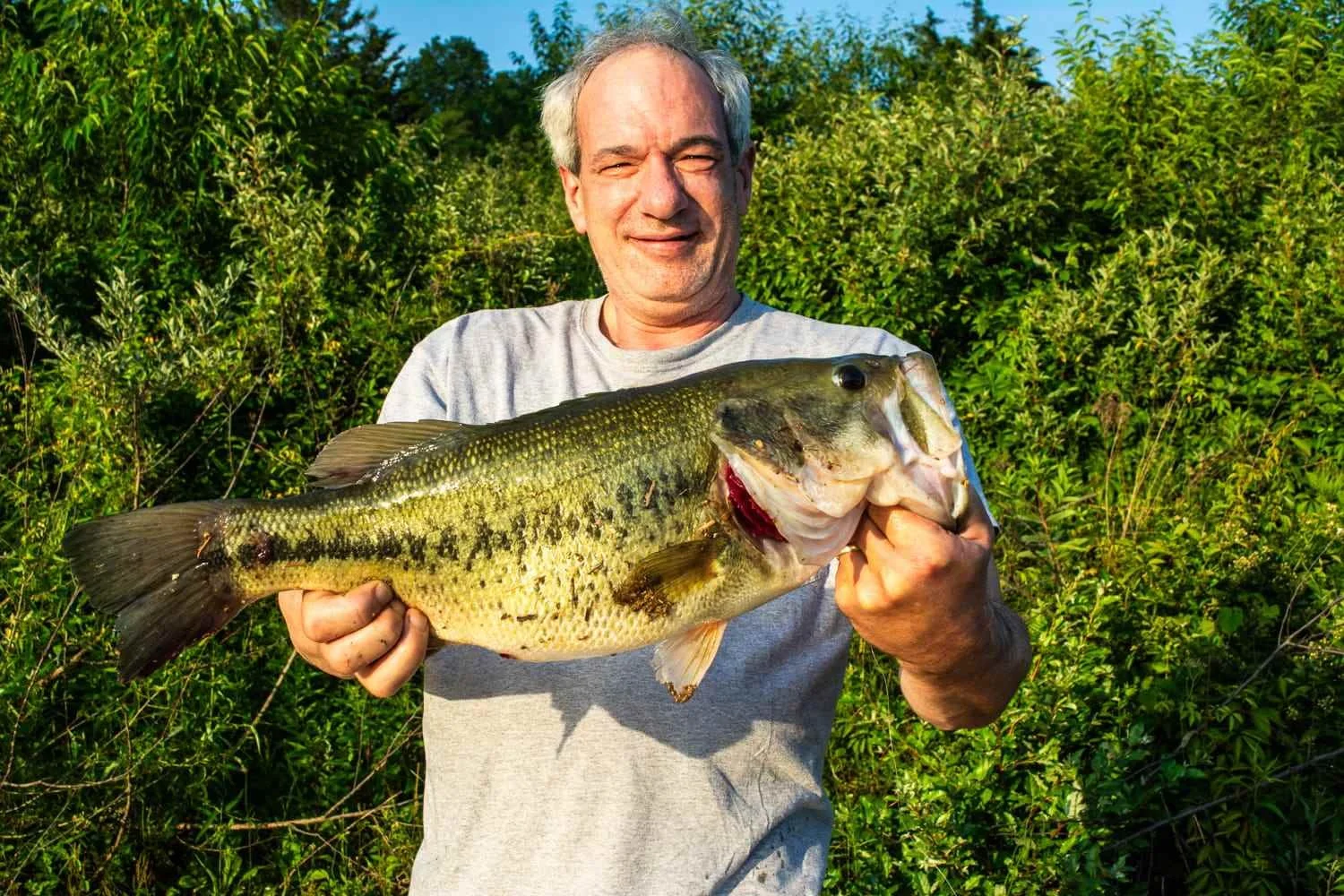
I could only guess the weight of this 23 1/4-inch largemouth. I figured seven-and-a-half pounds.
Stretching the Truth
I did get out and fish a little at a bass pond Thursday, catching a couple of sunfish, the water temp at 55. This post is yet another originally published in NJ Federated Sportsmen’s News, however, published by New Jersey State Federation of Sportsmen’s Clubs. It’s about catching big fish and knowing their size, not every big one caught gets weighed… But most big ones create stories that surround the memory of them. And besides, if you’re after big fish and want to know what they actually weigh and their measurements, it might be a good idea to entertain subject matter from someone who’s had experiences with such fish. Less about how to catch them, so much as what attitude you might take when you do. I’ll relate a few stories though the words ahead.
The tendency to stretch the truth is very seductive, and when the lie gets exposed, it’ s not easy to readjust. Most of these lies are falsehoods we tell ourselves. Usually, we’re just misinformed, but some anglers who stick to the facts with a responsible conscience don’t always admit what they actually know. To give an example of the truth being in question by a man who saw through his own tendency, I’ll refer to a novelist published by the Penguin Group who mentored my writing. (Penguin is very difficult to get published with.) My estimate of my mentor’s character was undiminished after I once visited him at Carrier Clinic, a hospital near Princeton for the mentally indisposed. His episode was temporary, and he did not lack insight. There he told me, with a distant twinkle in his eye, that anyone can suffer delusion without knowing that he does.
We anglers are often the butt of jokes about such a tendency. We tend to place a lot of value on size and numbers of fish caught, and reports about catches are sometimes at variance from the facts. During my teens, I relied on a De-Liar, a cheap spring-operated scale that seemed about accurate enough. From my experience using it, I got the notion that a 14-inch largemouth is usually a pound and-a-half; 16 ½ inches about 2 ½ pounds; 19 inches, four pounds; and the typical 20 incher, five pounds… although my fishing log does note a slim 20-incher that I weighed at four pounds.
Since I got serious about fishing again some 24 years ago, I’ve mostly relied on those standard measurements to judge weight. I’ve sought big bass, especially, and I’ve caught plenty of them without quite knowing their weight. For example, I recall a chunky 19 ¼ inch smallmouth from the South Branch of the Raritan River in 2023. Enthusiastically, and without actually weighing the fish, I declared it a most significant breakthrough for me at four pounds. Nearly a year later, I caught a similar one, this one from the Paulinskill (19 3/8 inches), and at the time I concluded it must weigh an ounce or so more than four pounds. I even mentioned these fish and their presumed weights in an article about small rivers for bass published by On the Water, only later coming up hard against the likelihood that both of those fish were probably less than four pounds by a couple or a few ounces. Maybe four or five. Disillusioned, I struggled to keep my memories of these catches intact. I had been so sure of that landmark four-pound mark.
Owning a Scale
I’m happy to report that since the time of a shakeup for me concerning fish weight, the memories of those two very nice smallmouths are safe and sound, while I feel all the more motivated to weigh a smallmouth at four pounds or better with my new and accurate electronic Rapala scale. Something big happened last Father’s Day that made me a believer in owning a good scale like that. I’ve tested it by weighing a five-pound bag of sugar. With my wife and son, I sauntered onto a sandy sort of narrow beach at Merrill Creek Reservoir, took my favorite St. Croix in hand, and cast as far as it could go a weightless Chomper’s worm, eight inches long.
I set the rod down, bail open, figuring that worm had a long 20 feet or more to sink to bottom. Did I think any chance existed of hooking up this way, when my main intention was to lay back on a towel in the sun with my family? I’ll be honest with you – I did think a catching a bass possible. I wanted that worm to sink through the deepest water to which I could get it, because that was exactly the zone I felt pulse with possibility.
After 10 minutes, I sat up, looked at my rod, and noticed the line was tight. I stood, took the rod in hand, and engaged the reel while noting with alarm that the line was moving. I tightened up and set the hook. Heavy. And when the bass went airborne, I felt my whole body sag with excitement under the weight of what looked like eight pounds. After an impressive struggle, I grasped the lower jaw with all of my right hand’s fingers, the three of us in awe of the fish as I set it in on wet sand and measured 23 ¼ inches. Beautifully, after all my time on the towel, the hook caught in the corner of the jaw as if the lunker had smelled the worm resting on bottom, sucking it into its mouth a moment before I sat up. The bass had a fat belly from swallowing a whole lot else. I released it to devour more.
On my blog, I reported that it might weigh seven-and-a-half pounds, but when I approached a neighbor’s porch shortly afterwards, he said, “Bruce, you really need to carry a scale.”
My brother Rick told me it might have pushed eight.
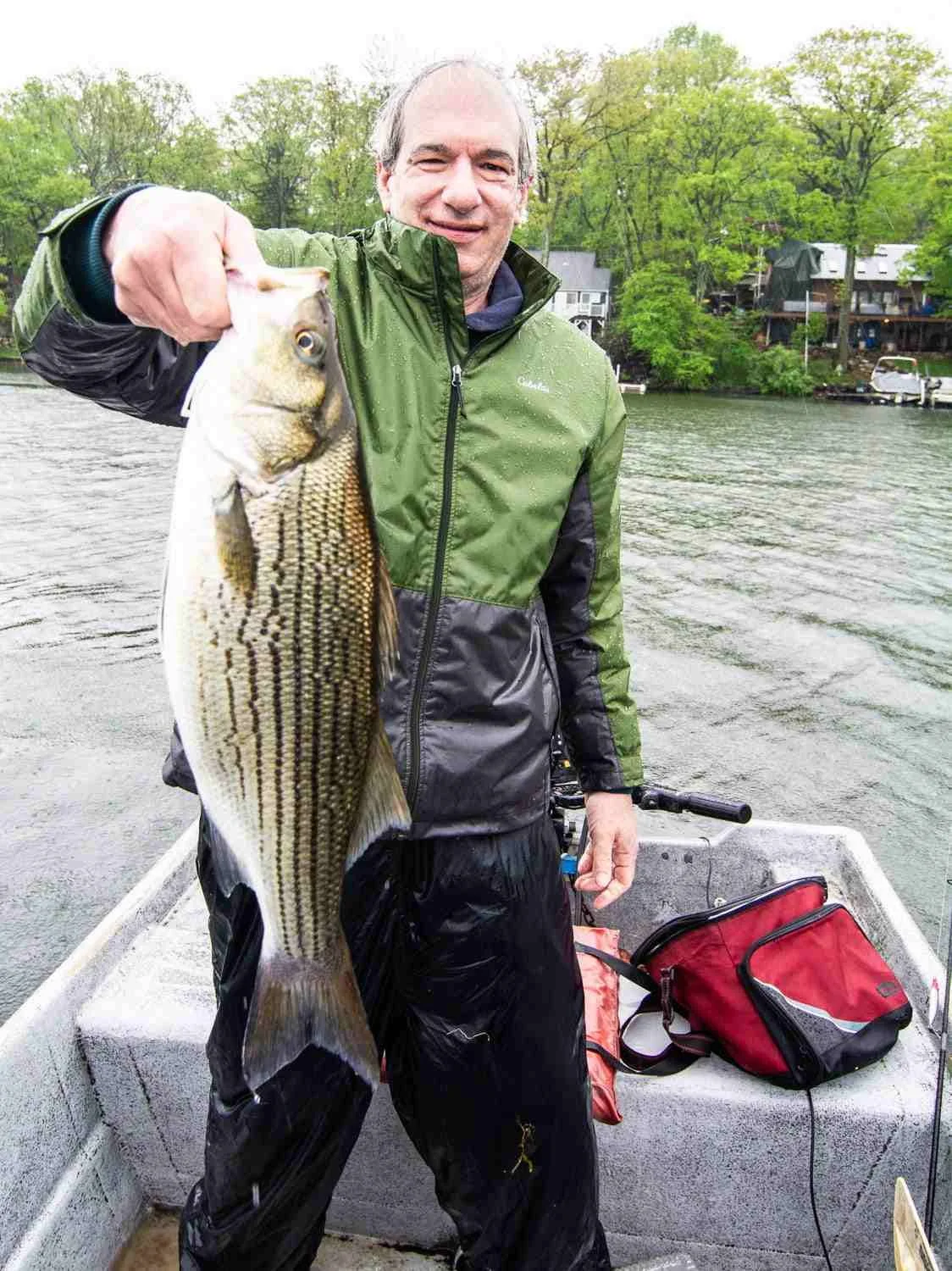
One of the hybrids I caught that day I had weighed-in at Dows—at five pounds, 15 ounces—while three or four others would have weighed over five but not that close to six. It was a great day in the rain, when, with my son, who caught his first hybrid over five, I managed to get over the ennui caused by working in a supermarket.
Weigh In
One of the advantages of fishing out of a Dow’s rental boat on Lake Hopatcong is the certified scale in the shop, which Laurie Murphy, Joe Welsh, or Jimmy Welsh will use upon your return if you need it. Two of the fish photographed for this article were so. Whenever we catch a big walleye or hybrid striper and decide to keep the fish, we have it weighed. (It’s worth mentioning that such fish could weigh a little more upon getting boated, because they might excrete waste while stashed in a livewell.)
Like largemouth and smallmouth bass, I’ve sought big hybrids and big walleye. Like the bass, to catch them, the main thing is to want to catch them. The brain alone can’t put you on fish. Desire works upwards from the gut, until it’s rarified as intellectual guidance. Learn all you can about how to catch big fish at whatever pond(s) and lake(s) you choose, and put in your time. My account about finding a big bass I I hooked at Lake Musconetcong last fall is less instructive, than it takes you into the story that might relate more than being told can certify.
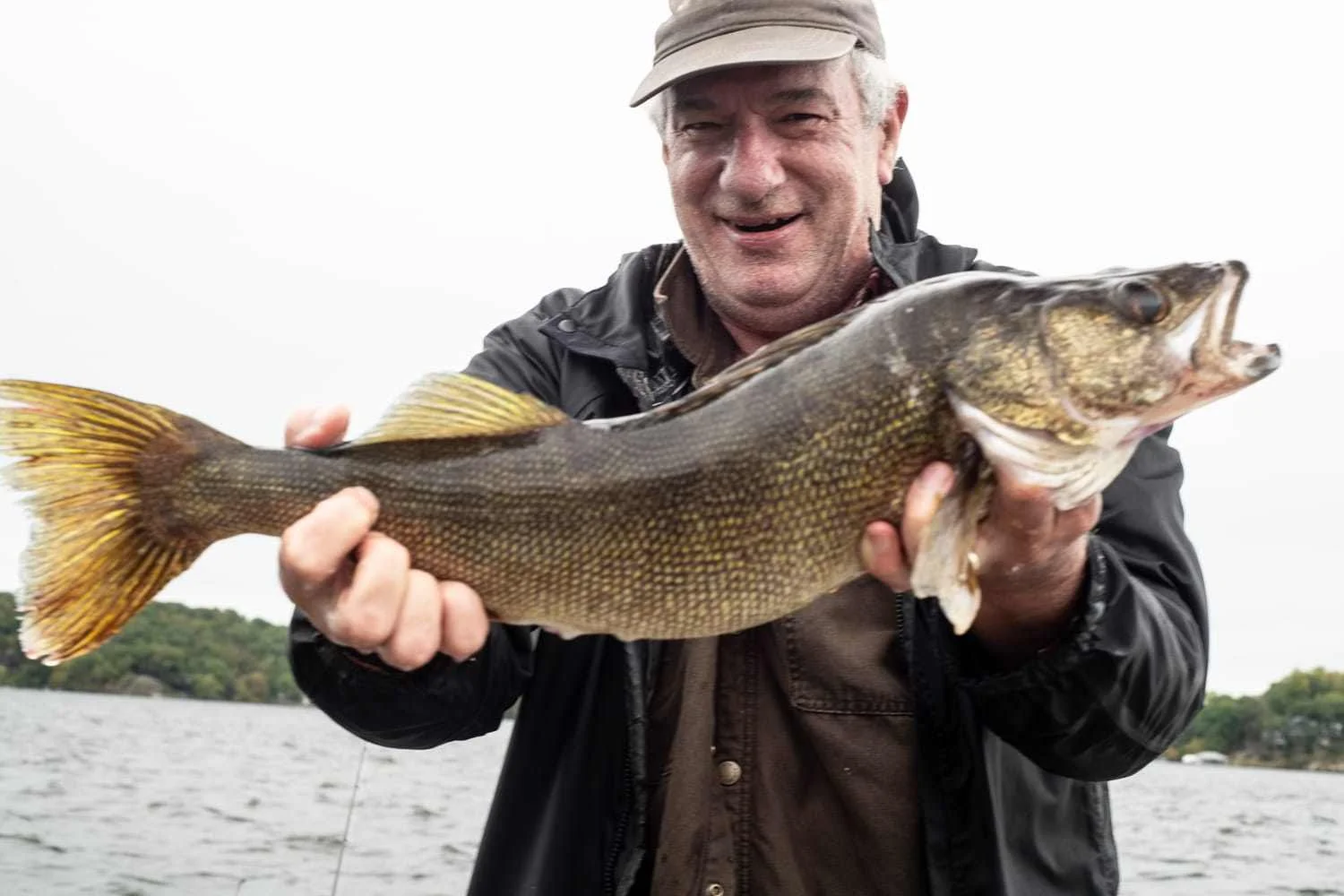
One of three five-pound, 15-ounce walleyes I’ve had weighed in at Dows since 2011.
At any rate, I know my biggest walleye weighed no less than five pounds, 15 ounces. I’ve caught three of them weighed exactly at that mark. It feels real and reassuring compared to the uncertainty about my largemouth. But why does size matter? Exact measurements don’t matter to all anglers, not even to serious anglers, because the struggle with the fish and the ambient surroundings sensed and associated with the catch and remembered; such aspects of experience as these comprise the real life of fishing. Not how the fish can be standardized by a tape measure and/or scale.
If fishing is not first and foremost valued as participation in nature’s beauty and excess—beyond simply taking stock—we might as well work in a supermarket seafood department, scraping a petty profit margin from a frozen block of fish. And yet size does matter beyond any doubt when a fish is on the line. The least of the issue involves drag. If the fish is big and the drag set too tight, that fish is lost. I’ll never forget hooking an immense striped bass that took a live-lined 15-inch bunker from the end of a jetty. When I set the hook, the feeling of inability to budge the bass felt great, and the way the fish slowly began gathering speed through the initial run reminded me of the sluggish start of a steam locomotive, but I was outfitted with 16-pound test monofilament on a surf reel with the drag set a little too tight.
It took me a long time to get over the loss of that fish because it was so big. So why not know exactly how big those that do get caught? Well, even nanotechnology could never measure the true exact weight of a fish, because atoms don’t stay put altogether in a specific entity, when you really get down to the issue. But by our standards of relative exactitude, a trusty scale tells me plenty. That’s all I need to know, not how many atoms it’s losing and gaining. Ever since Merrill Creek Reservoir, I’m a convert. That event is no less precious for a bass not weighed, but really, if I ever do catch an eight-pound bass, I want to know that.