Ice Fishing Public and Private
A good sized bass caught by the writer as snow fell on a public lake. Even if the lake you fish is private, it’s all the same given, natural world.
The article was originally published in New Jersey Federated Sportsmen’s News, published by New Jersey Federation of Sportsmen’s Clubs.
Public Waters Produce
Private waters aren’t all they’re imagined to be, but neither are public. To begin with, the notion of public waters as overfished begs the question of what defines that notion. You can gather plenty of evidence to support whatever your notion of overfishing is, but perhaps most of that evidence will include examples of fish caught. Even private waters are vulnerable to fishing pressure, but I’ve heard it best from Laurie Murphy at Dow’s Boat Rentals after a good ice season. She said the crappie fishing the next fall wasn’t so good, and I believe she was spot on about heavy public pressure from ice fishing as the cause. But don’t conclude Lake Hopatcong sucks. Besides, one good ice fishing season suggests there might be more yet.
Public lakes are among the most majestic. And as you can see, though tracks belie to former presence of someone with an ice fishing sled, no one is out there on the particular evening photographed.
I don’t believe the public resource in general steadily declines. The myth about the great fishing back in the day can get overworked. Any of our waters improve if fishing pressure subsides, and as Laurie Murphy implies, all that might take is a mild winter. Another example is fewer anglers on the water with the waning of the COVID pandemic. In any case, while I’ve written a lot about pressured waters during the past couple of years, what that can mean is that there’s a lot more fish in our public waters than seems. They’re just bait-shy.
Public waters produce plenty of pickerel. Catch and release is broadly practiced and eager fish like pickerel easily fall to shiner-baited tip-ups.
Public waters produce, though some do more than others, and finding out which is which involves experimentation by getting out there and fishing them. It’s not likely that anyone is going to draw up a chart to simplify matters for you. Unless it were expressly done for you alone, that’s a chart that couldn’t be reliable, given the possibility of its own influence. And you have to be skilled in the first place to catch fish, no matter how good the fishing is in general.
Some private lakes have yellow perch of outstanding size.
Private Ice
Rather than rubbing shoulders with the public, some of us have the option of fishing on private ice. For the last couple of years, I have done so by invitation, but it doesn’t mean I shun public ice. Last winter, I fished public ice more than I fished private, but I caught fish on private and got skunked elsewhere. Even so, catching fish isn’t everything, and though the pursuit can start to feel like a waste of time, any outing on ice that does have fish under it can be salvaged by taking active interest in catching them. Active measures, too. Like moving tip-ups and jigging different holes.
I’ll never forget Lake Aeroflex during early March 2021, because I had never before seen ice as pock-marked by holes both frozen over and open. It was amazing to contemplate how pressured the pickerel, largemouth bass, rainbow trout, and landlocked salmon, and I never got disgusted, as if the quality of nature had been hollowed out and destroyed by hundreds of auger penetrations, but I didn’t evade the fact of the invasion. I wondered if any fish had escaped sensing the commotion, and I oddly felt that if any flag were to go up, I would feel the fish’s interest differently than I would in a less pressured place.
Why conclude that pressure applies only to lures, when it’s obvious that bait under tip-ups is presented to fish unwilling to take it? It’s possible fish moved out of the area for less pressured parts of the lake, too.
Not only will virgin fields of unpressured fish be likely in a small private lake, it may be small enough to be free of seagulls, as evidenced by a piece of discarded bait that never got snatched up. There’s nothing wrong with gulls, but when they’re around—cormorants, fish devouring birds, usually are, too.
If you can fish private ice, the chances of finding virgin fields of fish-holding water seem pretty good. My friend Brian Cronk invites me to the private lake both when open and when frozen over. Not only does it make comparison to public water interesting, the comparison between when it’s open and frozen over is interesting, too, which I’ll get to in a moment.
Fast Action on Public Water, Too
About 15 years ago, I witnessed a couple of ice fishermen coming off Lake Musconetcong, with nine pickerel, almost a limit apiece. Nice ones, some about two feet long. Morning light was still young, so they had racked them up. The incident serves as an example of fast action on public water, though since then, Lake Musconetcong has been chemically treated for invasive water chestnuts, and to the best of my knowledge does not fish as well. Before the chemicals changed the lake, you could read the date of a dime in its deepest six feet of water. Fred Matero and I fished a section of Musconetcong from shore this past June. It used to be my favorite lake. The water had a muddy tinge, and we caught nothing.,
Cronk and Sam Kaplan remove a hook quickly, as action on the private lake was fast.
Fast action on private ice might be expected. Both times Brian and I ice fished the private lake, once with a number of other anglers who knew someone who resides there, tip-up flags began flying almost as soon as we began setting them, but that didn’t mean we could cut holes and set bait anywhere and get the same results. We did experiment with setting tip-ups in various spots and got different results, but the fishing does suggest, as it probably will again this January, that a greater abundance of less pressured fish exists than under most public ice, which shouldn’t surprise anyone. The interesting thing is the discrepancy between the size and kind of fish we catch when water is open compared to when it’s frozen.
Beautiful pickerel over 22 inches from a private lake.
When open, we catch more largemouths than pickerel. So far, we’ve caught only three largemouths through the ice, many pickerel, and a number of good-sized yellow perch. But when we catch open water pickerel, they’re usually well over 20 inches and as many as 25. Why they’re usually about 17 inches when caught through the ice, I don’t understand. We have yet to see one over 23 inches. The shiners we use are large, so it’s not as if small bait is amounting to small fish.
Best I can tell, we’ve set tip-ups where smaller pickerel occupy the water, relative shallows with residual weeds. Perhaps if we were to scale down the size of our lures and cast them in such shallows when open, we’d catch smaller pickerel. Maybe greater success is just the matter of setting tip-ups elsewhere for bigger fish, sacrificing that flurry of flags, but the rate of return might come to resemble that of some public waters.
We had 88-acre public Tilcon Lake to ourselves, and we caught fish, too.
The only certainty is more experience gained and that new inferences can be drawn, leading to new uncertain conclusions as familiarity nevertheless grows through a learning process that does make catches predictable…and eventually might lead to trying somewhere new. If it gets too easy and familiar, what’s the point? Brian and I had an objective that didn’t take too long to fulfill. A five-pound bass. We didn’t weigh the fish. We got it back into the water quickly. But we did measure it at 21 inches, so if not five pounds on the mark, close enough. Pickerel eat under the ice, no doubt, and yet, so do bass. Why haven’t Brian and I caught more?
Many years ago, each winter when ice was safe in Mercer County, friends and I fished a six-acre public pond that got a lot of open-water pressure during the early season. Its deepest water is 12 feet. We enjoyed days when flags flew so frequently it was as if the bass were eager to shake our hands, but why does the private lake Brian and I fish compare unfavorably?
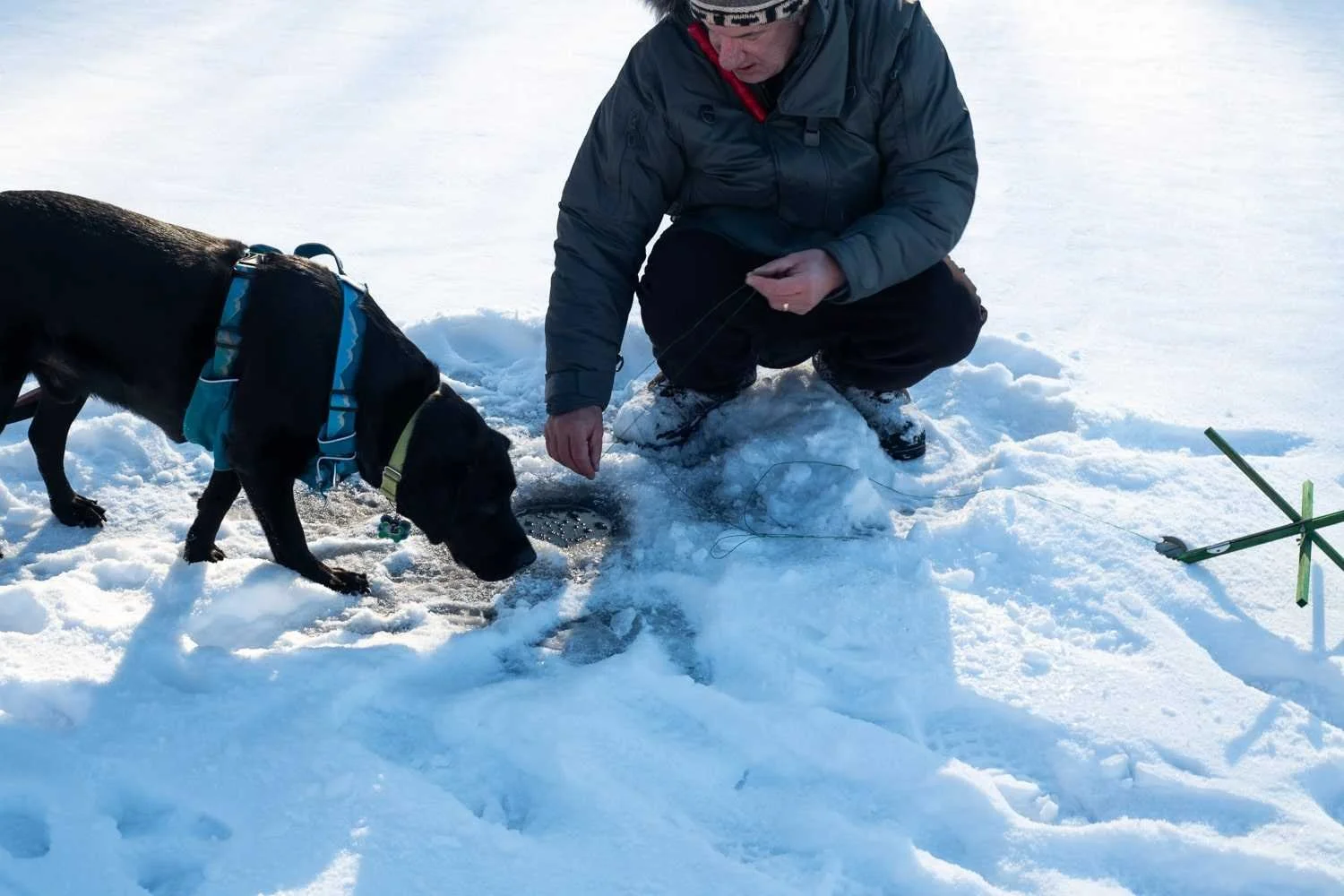
Dogs are allowed on many public lakes.
One thing stands out from these comparisons: Fishing is not all about action. If it were, it would get boring just as fast. A game is a thing of the mind. A process of overturning obstacles to scoring, and by applying the mind to new fishing situations, we challenge ourselves, learning things that amount to success in our private space—even if the water is public.
How can I compare the ice fishing on the private lake to the ice fishing I enjoyed on the six-acre pond? Even if we do find some bass, my bet is that we’ll never find them as concentrated as they were in the 12-foot depths of that pond, because our favorite lake is rather shallow and has no such spot, but we know it has a lot of big bass, because we’ve caught many when it’s been open. Just one of them through the ice will make a big difference.