South Branch Raritan River Fishing
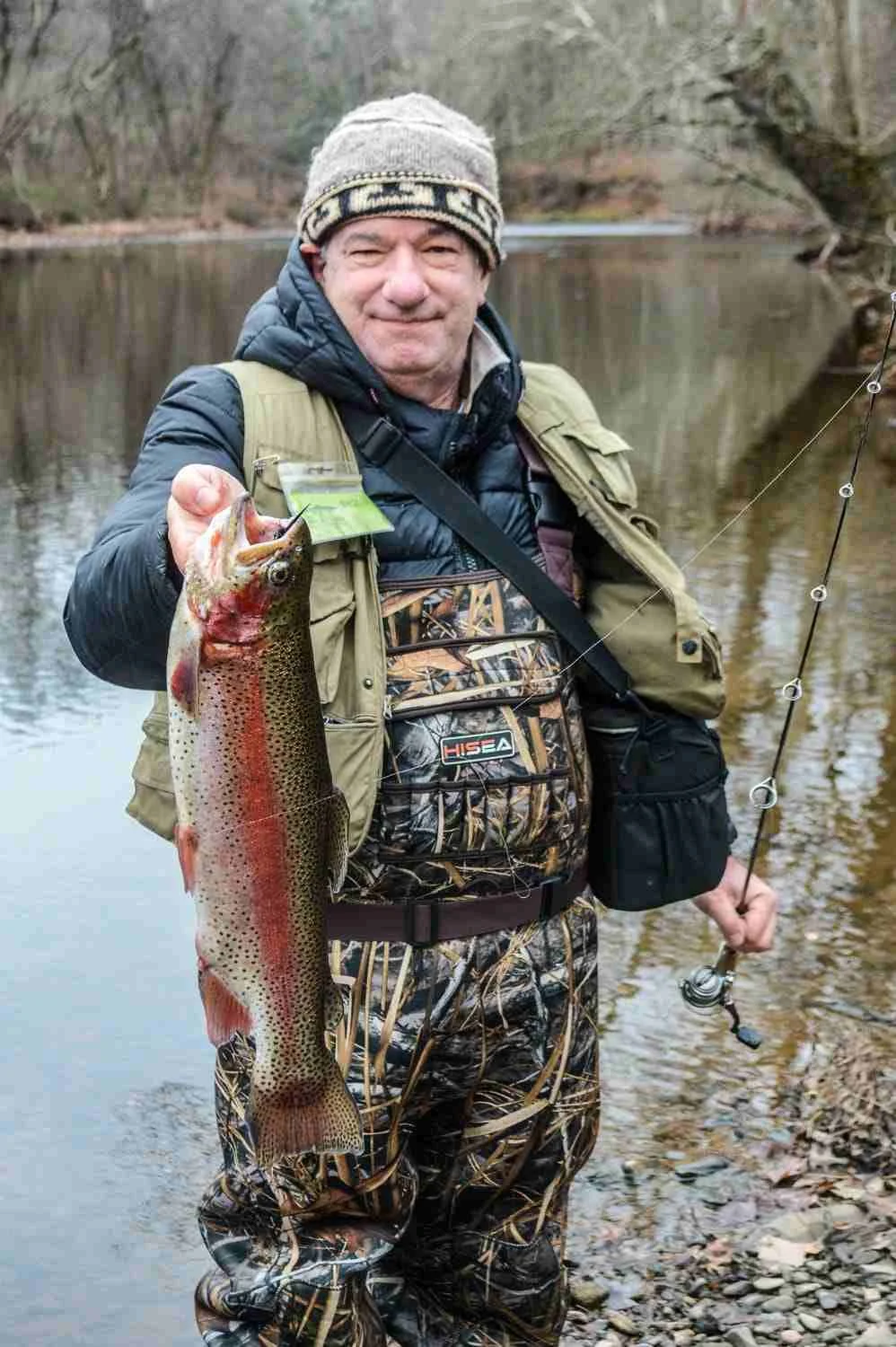
A 4.23-pound rainbow trout caught by the writer on a black maribou jig in the South Branch middle flow south of Clinton.
Trout and Bass Fishing
Here’s another originally published in New Jersey Federated Sportsmen’s News, the publication of the New Jersey State Federation of Sportsmen’s Clubs. Think of the river as a two-tier fishery, trout and bass. Smallmouth Bass get caught all the way up to Califon, though the river is not a wild trout fishery from Lake Solitude Southward. The lower South Branch has largemouths, although smallmouth bass remain prevalent.
Shot taken from the Confluence, facing the North Branch Raritan.
Fishing for stockers with salmon eggs in the upper South Branch Raritan at Califon.
The Upper River’s Flow Characteristics
When I think “South Branch,” I imagine the river’s lower reach. Flowing through Hillsborough to the south of the North Branch, the river has taken that southward dip while progressing from west to east and finally south to north as it arrives at the Confluence. The North Branch flows downward to that Confluence. Otherwise, the South Branch might as well have been named the “West Branch” in relation to the “East Branch.”
Regardless, the South Branch courses 51 miles to the Raritan River from its beginning at the outflow of Budd Lake. That’s where it’s an especially small flow, although I shot a photo from Manor Road (before the river crosses under U.S. Highway 46) where it is wider before it cuts down the mountainside. If I’m not mistaken, though, it squeezes underneath 46 as a very narrow flow.
The river at Long Valley is even smaller than at Califon not too far below.
I’ve been looking for that photo, but I’m starting to think I need to go there and shoot another. In the meantime, I’ve added the one above. No dam exists at Budd Lake; the lake is entirely natural, elevation above sea level at 928 feet. Many years ago, I believe I spoke to someone from the Division of Fish & Wildlife who told me native brook trout exist within a quarter mile of the river’s origin. Someone told me that, and I’m all but certain he had a fisheries position. Long Valley, eight miles downstream as the river flows, sits at the mountain’s base at 554 feet above sea level. Brook trout certainly exist there, but brook trout appearing so suddenly after the river leaves the lake’s warm water during the summer, they indicate that the stream is heavily spring fed as it swiftly descends just a quarter mile from the lake.
Until the river reaches the dam 400 feet upstream of Flanders-Drakestown Road in Mount Olive Township—not yet as far downstream as Long Valley—the fish are native brook trout. From that dam downstream to another one 200 feet upstream of County Road 517 in Long Valley, the river is managed for multiple wild species. The Claremont stretch is above Long Valley but below Flanders-Drakestown Road, and yet it is well known for its reproducing brown, brook, and rainbow trout. It is not stocked. According to Gerry Dumont, a South Branch Outfitters guide, “The area (of the Claremont) where the Electric Brook flows into the river is especially good for brookies.”
Brookies are not common below the Claremont. An April occasion in Califon became interesting in that respect. Mike Maxwell and I fished stockers when a friend of his showed up with a fly rod and introduced us to a tiny size 22 Rainbow Warrior attractor pattern. Keeping up with Mike and I at catching stockers, he suddenly hooked an OK fish, which turned out to be a 14-inch brook trout. That was 2017, three years after brook trout stopped getting stocked by the state, although I guess Shannon’s Fly Shop stocked brook trout in the private stretches above town, although I might be incorrect on that.
When the river gets low, the Ken Lockwood Gorge can look like this, with barely enough flow to see water, let alone fly fish. I mounted my camera on a tripod and used a slow shutter speed to get the soft flow effect.
From the dam at Long Valley downstream to the Lake Solitude Dam below Ken Lockwood Gorge, the river is designated by the state as “Trout Stocked Stream-Wild Brown Trout Managed.” Wild browns get caught in the Ken Lockwood Gorge below Califon, and I’ve heard of one or two caught below the Lake Solitude Dam, but for wild browns—think KLG and upstream. I know stocked rainbows get caught in August as far south as Stanton Station near Flemington, and for that matter, even at Duke Island Dam on the Raritan River, but I’ve never heard of brown trout in these waters besides Brenden Kuprel’s good one caught at the Island Farm Weir below Somerville in March 2024 on jig-headed swimbait. From Mount Olive Township through the KLG, Gerry Dumont regards the South Branch as the richest brown trout river water in the state. While the river may be fishable for trout on cool mornings into June, it’s best to refrain from trout fishing when the water temperature is above 68, because lactic acid buildup during the fight may prevent healthy release.
It’s not as if fly fishing for smallmouths—whether in the upper river to Califon or down below—isn’t productive. My brother Rick and I floated from Stanton to Flemington with nothing but a couple of fly rods, catching bass.
Nineteen-inch smallmouth caught on a Yum Dinger while float tripping the lower South Branch Raritan.
Aquatic vegetation is thick in the lower South Branch during summer. The lower river is rocky, too. Notice the shale or other sedimentary stone.
Even lily pads grow on the lower South Branch.
Tractor tire being removed from the lower South Branch Raritan by Central Jersey Stream Team. Photographed in 2016.
Andy Still is a legendary lower South Branch Raritan presence, who has removed unknown quantities of tires and other refuse from the river. Photographed in 2016.
The Lower South Branch Raritan
The South Branch offers other opportunities. Personally, I’ve caught smallmouth bass from the area of Studdiford Bridge near the Confluence northward to High Bridge, but Dumont told me about a three-pounder caught by a flyrodder in the private water above Califon. I’ve tried Califon for bass on one summer occasion but failed. I used Yum Dingers, which I catch bass on elsewhere in the river.
From Clinton southward, the river has been called the best smallmouth bass water in the state. No matter how it really stands up to the Delaware and other rivers, not to mention lakes and reservoirs, it is a legendary bass river from which a 6.6-pound smallmouth got weighed in at the former Efinger Sporting Goods in 2010, according to The Fisherman magazine. Perhaps not even the Delaware boasts of a bass quite as big. Otherwise, I’ve heard of them as big as 5.5 pounds from the South Branch. I’ve enjoyed bass fishing while floating the river that still amazes me long after. I doubt any other water in the state is as good, and I’ve fished many of them to compare, including many productive outings on the Delaware.
Smallmouth bass 19 and even 20 inches long get caught frequently. Ned rigs, Senkos and other brands of the same type of worm, jerkbaits, topwaters, are the Big Four, but bass get caught on spinners, swimbaits—you name it—and that’s not even beginning with the opportunity they are for the use of five- to seven-weight fly rods. The late Jim Holland—who used to own Shannon’s Fly Shop, now South Branch Outfitters—gave me a couple of white, helmet-headed sculpin flies to try in the river. I did. I used my seven-weight St. Croix Avid, and I hooked up. It’s been years, but I still have one of the flies, and it’s likely I’ll try again.
Jim also wrote a fly fishing column for the Black River Journal I read. It was in the context of his being the writer of that column that I first met him—introduced to me by Chris Lido, who had formerly been my editor at the Fisherman, and I believe was a fly fishing guide from Shannon’s at the time. The three of us had business at Fiddler’s Elbow Country Club. My job was greeting members and others who had reason to enter the compound, while Brian Cowden and Urbani Fisheries restored the Lamington River there. Shannon’s served at the liaison between the club’s river sections and the stocking of them by the Musky Trout Hatchery.
A 17-inch largemouth I caught before the sun came up in Hillsborough, on July 3rd, 2025. It took a 3/8th-ounce Rebel Pop-R fished in the shallows beside wood in water, with deep water immediately accessible to the fish.
Largemouths are less common, and I believe the largest I’ve heard about is four pounds. Word of that fish came from Kevin Ortiz, who guides on the river. I caught one close to 2.5 pounds in Neshanic on a big, live killie I had brought home after fluke fishing the surf. In Hillsborough, I measured one at 17 inches I caught on a 3/8-ounce Rebel Pop-R before sunrise..
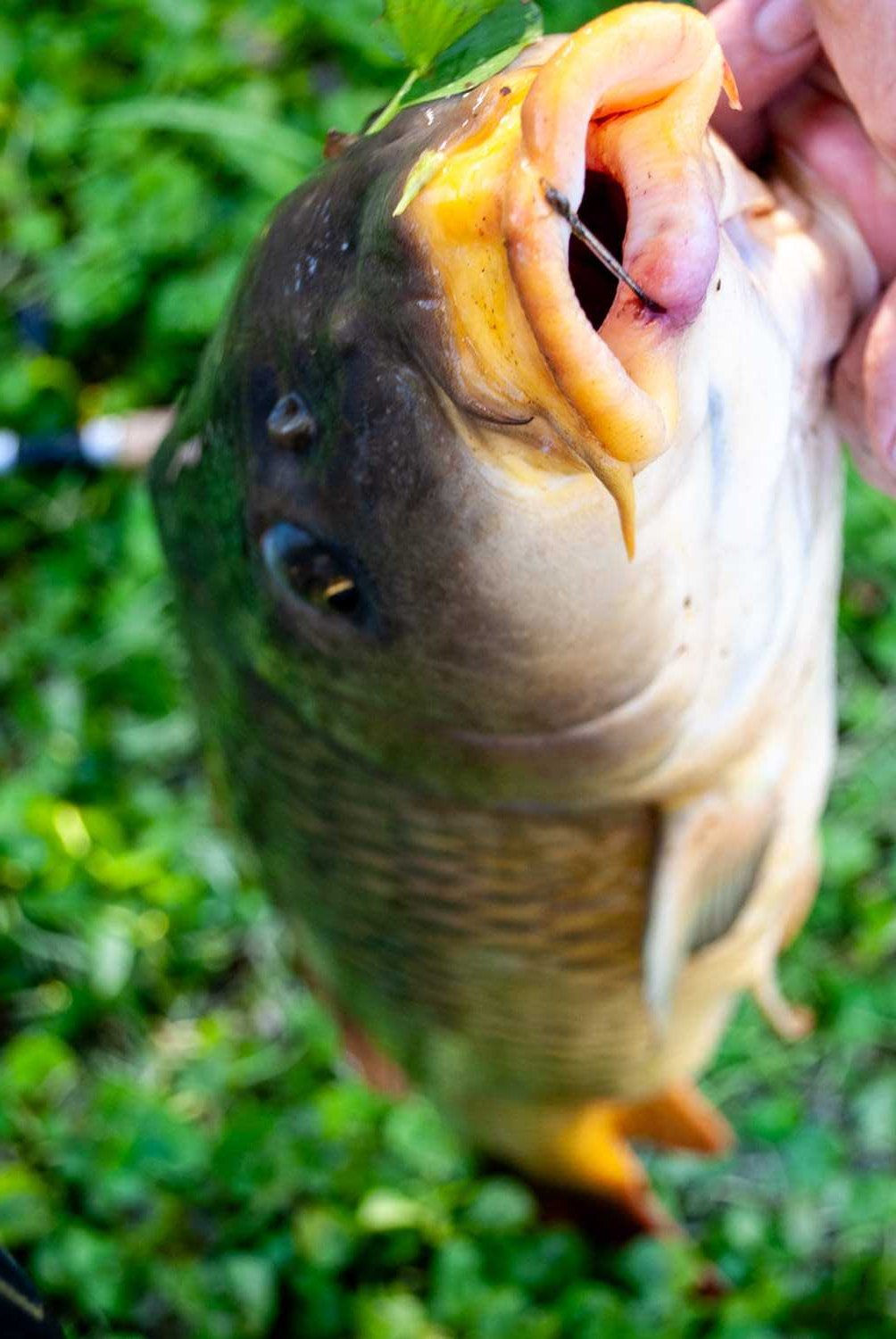
A 31-inch carp that took a Senko intended for a smallmouth bass. Fought on six-pound test mono, the struggle was outrageous.
Carp and Pike
Big fish—not only big bass and outsized stocked rainbows and privately stocked Bubba browns—exist in the river. In 1995, Billy Friedman caught the state record common carp from the South Branch, weighing 47 pounds. Carp inhabit many deep holes and stretches, though you won’t find any in the KLG!
At Neshanic, I caught one 31 inches long on six-pound-test mono. It took a Yum Dinger into its mouth intended for a smallmouth, and I will never forget the fight that fish put up!
Even northern pike have been caught in the river. Decades ago, my friend Joe Landolfi offered me glowing accounts of fishing smallmouths. On one occasion, he told me, he landed a 30-inch northern. I’ll mention The Fisherman again. The magazine featured an article about catching northerns in the river. A very few come from Spruce Run Reservoir and possibly from Budd Lake, too.
Stockers can be quite good to eat, despite the persuasion against them. My wife and I used a breading with various spices and added eggs. Haven’t seen the breading in the supermarket, but I’ll be looking online. They’re put in for most of the river’s length, so we’ll revisit spots upstream as I bring the story to a finish.
Stocked Trout
Despite the many opportunities, far and away most fishermen pursue stocked rainbows during springtime. I’ve been under the impression that trout get stocked a good way upstream of Long Valley at Bartley-Flanders Road, but what I’ve read indicates that from the mill dam 200 feet upstream of County Road 517 in Long Valley, downstream to the Confluence—that’s where trout get stocked.
It seems as if each stocker fisherman in a crowd has his own idiosyncratic way of catching stockers. Fly fisherman use Rainbow Warrior patterns tied on the same tiny hooks as zebra midges. That’s not to mention the hundred other patterns that catch fish. You find a lot of fish get caught on Power Bait, but I don’t recommend the stuff, because it’s ugly and awkward. I feel differently when fishing the stuff from the shore of Round Valley Reservoir. Besides, you can tell me my salmon eggs create an oily mess on waders and clothes, and that the oil smells, but I like the smell, though I readily admit I try to keep the oil off my clothes. In reality, I can’t do that all the time, so I accept the fact. On extremely light tackle—the word for it is microlight—salmon eggs are very effective on stocked rainbows, though I always tip my hat to others who do as well using other methods. My good friend Fred Matero does very well on tiny jigs and an ultralight rod.
The river is popular for fall stockers, also. Only on two occasions while fishing the river during the winter, however, have I run into another angler. Like during springtime, most fishermen are eager to catch them when they get stocked and have no stamina to pursue the fish that remain until March. But quality fishing is available during the bitter months of January and February. It’s best to go when early afternoon temperatures reach at least 40 degrees, as even a slight rise of water temperature makes a difference to the trout. You’ll be comfortable in neoprene bootfoot waders, find solitude, and you may find the happiness of connecting with good-sized rainbows making winter literally come alive.
I’ve been fishing winter trout seriously for only a few years and don’t go terribly often. I’ve been fishing nothing but black marabou jigs, most of them 1/16th ounce, sometimes 1/8th. I believe I caught one trout on a white marabou jig, but on one occasion, a pod of trout ignored the white. I switched to black, and they chased it down, competing with each other. And that was on a sunny afternoon with light in the water. So far, while most of my trout have been average 14- to 16-inchers, I’ve caught a 4.23-, 3.85-, 3.88- and 5.3-pounder. Great trout stunning to have encountered.