On the Jetty
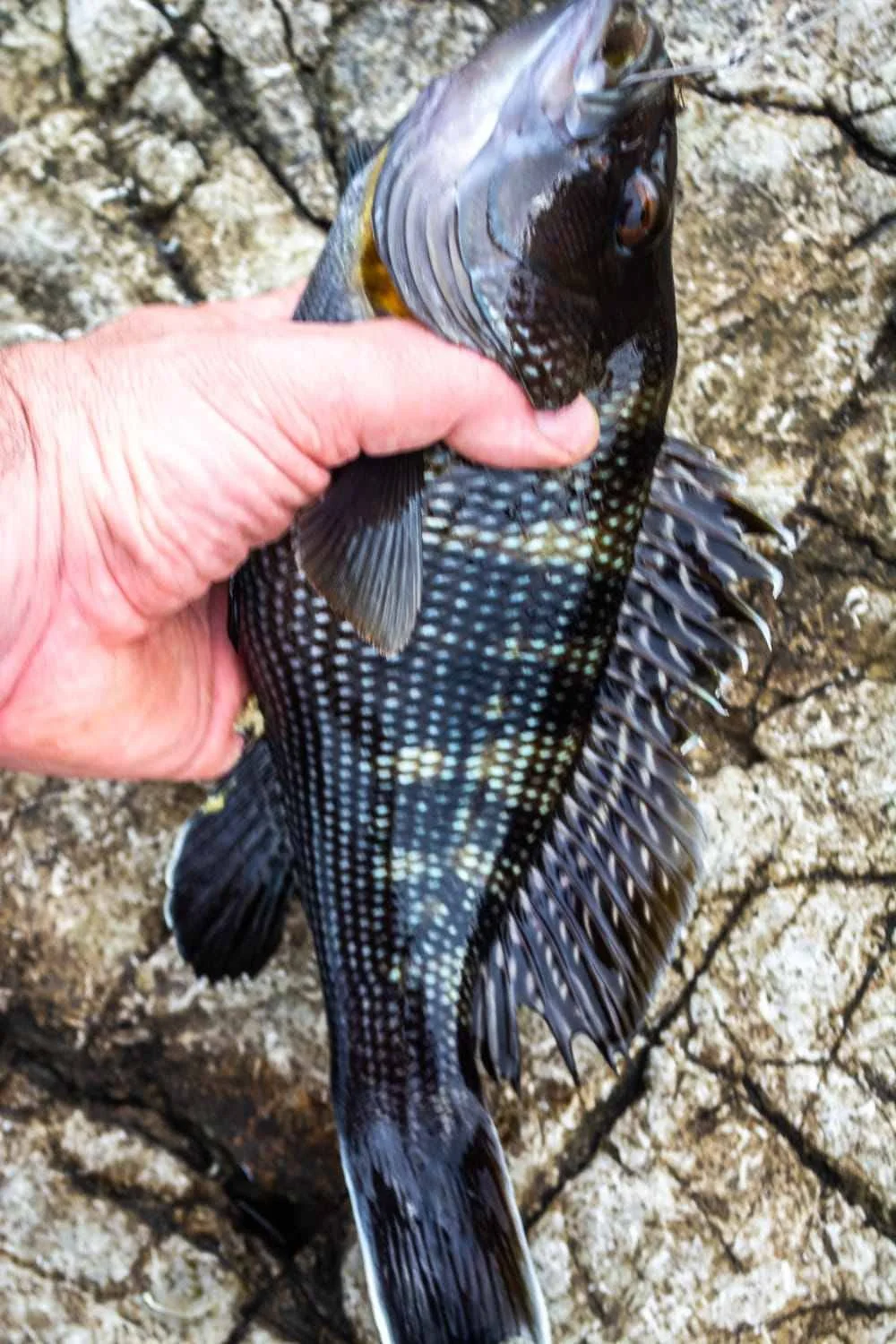
A good-sized triggerfish caught on Barnegat Inlet’s South Jetty. Notice the sneaker in the left lower corner, covered by Korkers. Korkers may save you a broken arm when the rocks are wet.
Numerous Inlets
Once again, I’m posting an article originally written for New Jersey Federated Sportsmen’s News, published by the New Jersey State Federation of Sportsmen’s Clubs. I tell myself I might add to this post in the beginning of September, because I’m hoping Fred and I fish Barnegat Light at the end of August, but adding to it … good idea, but I’ve just been so busy …. At any rate, New Jersey offers so many inlets to try, but Fred and I do always end up at Barnegat Light.
Barney’s Tower, to affectionately name Barnegat Light.
Any inlet jetty on the Jersey Coast is a hotspot. Shark River, Manasquan, Little Egg, Brigantine, Absecon, Great Egg Harbor, Corson, Townsends, and, of course, Barnegat. They’re all hotspots anytime from April through November, offering anyone the chance to catch fish. I’ve done most of my jetty fishing at Barnegat Light with Fred Matero, so most of what I have to say and have photographed is coming from there. I don’t recall us ever getting skunked. Advanced techniques exist for fluke, striped bass, and other species. Good ones are explained in The Complete Guide to Surf and Jetty Fishing by the late Milt Rosko, an excellently written and informative book, which almost inspired me to go try a jetty for stripers, using bucktails. But I’ll write about blackfish, fluke, black seabass, triggerfish, and bluefish instead, because they’re within the limit of my experience, besides some bergalls.
Fred Matero with a 17-inch blackfish from the Barnegat Jetty.
Fred Matero with a nice fluke from the ocean side of the jetty at Barnegat Inlet, caught on Fishbites.
A Barnegat jetty seabass just short of keeper size.
Catching Fish
These species I mention, any beginner can catch from the rocks of any jetty. I fished Manasquan Inlet jetty at age 10, catching bergalls—also called cunners—with a friend. My father patiently supervised us. I tried the South Jetty at Barnegat Light unsuccessfully for blackfish in 1982, but I was closer to catching some on green crabs than I knew. Twelve years ago, my son and I caught fluke and little seabass at Manasquan Inlet on killies, and in 2021, I began fishing Barnegat Inlet’s South Jetty with Fred Matero every six months or so. We’ve been catching blackfish, fluke, and some black seabass and blues. We walk from the parking lot of Barnegat Lighthouse State Park all the way to the jetty’s end.
If we add sheepshead, redfish, and surf speedsters like albies and Spanish mackerel to the list of catches, you might hear from me about that. For now, the bait and lures involve mole crabs (sand fleas), green crabs, killiefish, Fish Bites twister-tails, metals, and other jig and bait combinations I’ll mention in a moment. For years, I preferred killiefish for the fluke, while Fred preferred to catch them on Fish Bites jigged. I’ve switched to using an anchor jig of at least half an ounce with a Gulp twister on it. A Gulp Z-Man Elaztech plastic serves as the teaser. I have tried Berkley Gulp Jerk Shads and have caught fluke on them, but I don’t like them as much. They feel unwieldy on the retrieve.
Green crabs we’ve especially used in April, catching tautog.
Moles crabs—also known as sand fleas—raked from the surf.
Mole Crabs, Other Bait, Other Species, Rigs
On the way to Barnegat Light, we’ve sometimes made a stop where Fred’s broken out a crab rake, which he uses in the surf wash, collecting mole crabs. The crabs are everywhere and dozens can be collected in minutes during the summer. You might freeze some for use in April and other cold-water months. Along with green crabs and Asian crabs, they catch blackfish, seabass, and triggerfish. I’ve watched Fred catch bluefish on metals. But for the other species, from 20-pound-test monofilament, Fred ties hi-lo rigs we weight by one- or two-ounce bank sinkers.
Especially high tides that reach way up along the jetty near the lighthouse, bring brine and nutrients to Asian crabs that hide among rocks.
My eight-foot Tica spinning rod and 20-pound-test braid serves those rigs well. Whatever rod with some backbone you might use to cast them, not as many get lost to the rocks as you might expect. When you do get hung up, and it will happen, you can usually work the rig free. If you must, walk on the rocks at the opposite angle in relation to where it got snagged.
When you hook a blackfish, it’s necessary to horse it away from the rocks. Immediately, it tries to get under. Blackfish are very hard-fighting, and when you hook one over two pounds, the struggle to keep its head clear of those rocks is intense. Most won’t be keepers. Fifteen inches is the minimum size, but they average about 13 inches. It’s possible to catch 30 or 40 of them before bringing a keeper onto the rocks. And if you like eating fish, you should set the goal of catching a keeper. They’re delicious. You’re allowed one fish between August 1st and November 15th, but five fish between November 16th and December 31st, although fishing a jetty for blackfish late and very early in the year is beyond advice I can give. Between April 1 and April 30, you’re allowed four.
Fred and I have caught them in April, when the warmwater season begins to arrive. They get caught in close and as far out as you can cast, but Fred and I find most of them to be closer in to the edge. Another delicious jetty fish is the black seabass, and although catching a keeper of 12.5 inches is a challenge, it does happen on the jetties. Between July 1st and August 31st, you’re limited to one fish, but you’re allowed 10 between October 1st and 31st, 15 between November 1st and December 31st, although fishing a jetty around Christmastime might be a challenge that doesn’t pay off.
My theory about the camouflage of a juvenile gull, is that they fly less than the adults do, so they’re around rocks and on sand more. Just a thought.
During the warmer months, too, you’ll have less solitude. Not only because people walk the jetty, but various wildlife, especially birds, associate with it. I’ve heard of seals spotted, even a whale.
Regarding warmwater fish, triggerfish are usually thought of as a southern delicacy. They surely served our family’s dinner fare in Florida, but we ate so many different species of delicious fish, I don’t remember specifically, though I do remember my son or myself did catch one. Searching online, I’ve found no regulations on size or bag limit. They’re a prize catch not as common as blackfish or seabass.
Another crabeater is the sheepshead, more greatly coveted than triggerfish and an even less common catch. My son and I have caught them in North Carolina, and they’re some of the best fish we’ve ever tried eating. Mind you. I caught a nice fish in the Florida Keys. I was warned of the 39-inch barracuda as being poisonous, but I went ahead and roasted it. That barracuda was the biggest and one of the best-tasting fish feasts my family has ever enjoyed. But for sheer culinary pleasure, if I had to choose between barracuda and sheepshead … you know the answer.
In North Carolina, Ryan O’Neil, an Ocracoke Inlet charter captain, catches mole crabs (called sand fleas there), which sheepshead strip from hooks left and right. They’ll prove to be bait stealers along New Jersey jetties, too. But you manage to hook up after so many steals, and the fight is intense. The dinner is great beyond any doubt. Fluke as dinner fare need no further word for support, but the best way to catch them from jetties is to fish the side opposite to the inlet. It requires some walking to get beyond where breakers slosh against the rocks, but fluke will be there during warm months, even chillier, all the way out to the very end of the jetties. Some do get caught on the inlet side, but you might be surprised at how many prowl the sands out beyond breakers.
The ocean side of Barnegat Inlet Jetty is where to expect fluke. They get caught from the sands of the beach, too, all the way south to Holgate.
It’s a matter of casting straight out as far as you can muster and retrieving back. If they’ll hit a quick jigging retrieve, great, but I have the patience to slow it way down, and I believe anyone can do that. Keepers over 18 inches are common, though not as common as smaller, and you’re limited to three keepers. Season closes on September 25th, 2026.
We’ve encountered cocktail bluefish from the late summer jetty. When you see fish breaking the surface, reach for a metal, but you never know. During September, they could be albies, bonito, Spanish mackerel, or even blueback herring. Bluefish don’t mind a wire leader, but Spanish mackerel will reject a metal even on a very fast retrieve if you use a wire leader. They’re so quick they can stabilize at high swimming speeds and with their unusually acute eyesight see that wire even as you burn the lure. Use fluorocarbon. The stuff is all but invisible.
Make sure to connect it to braid by uni-to-uni splice (knot) not a barrel swivel. The leader should be at least five feet long. It’s a tall order to prepare all that if the Spanish are raising hell, but do it and have faith in some of the fish being there when you’re ready for them. During May until early June, expect gator blues pass through inlets.