Largemouth Bass Fishing in Small Ponds
The bass weighed almost two-and-a-half pounds, while the pond might have measured two surface acres.
So Much for 92-Degree Water
Sorry I’m so late at posting this time around. I have a lot to say about fishing small ponds for largemouth bass, a pursuit so close to my heart that even in recent years, I’ve done it. Even though I’ve been doing a lot more lake fishing.
Instead of working on my blog, Thursday I fished the Passaic River, the air enclosing Oliver and I at 102 degrees F. I kind of wondered why we were getting no hits … until I finally checked the water temperature and got 92. (I doubt it was that warm out there in the main current and three- and four-foot depths.) Oliver found a feeder stream, beyond where I decided to go no further, and found it “ice cold,” so I wanted its temp taken. Oliver trekked back and got 61 degrees. Not much above ground water temp, if this information I’ve linked to is an accurate estimate.
Then my wife and I lost power on Friday; only a couple of hours ago it came back up.
It’s another New Jersey State Federation of Sportsmen’s Clubs article, by which I mean it was originally published in New Jersey Federated Sportsmen’s News. I do some edits to improve upon these articles. And invariably I add content, in addition to posting more photos than the Fed publishes.
If you can’t fish the lakes because you have no boats, you can fish little ponds so long as you have some form of transportation. But I talk about two ponds within walking distance of my house.
A little pond with a calm surface so inviting to topwater fishing once the sun gets low.
Little Ponds of All Waters
Largemouths exist in many different waters. They thrive in quarter-acre ponds, just as they do in Lake Hopatcong, New Jersey’s largest lake. Little creeks have them, and not necessarily sluggish mud-bottomed ones, as well as the Delaware River. For this article, I’m thinking of ponds of a few surface acres at most. It won’t be about smallmouths, because the smallest pond in New Jersey that I know of containing any of them is 12 acres.
Many decades ago, my fascination with largemouths began on the practical level at a quarter-acre pond in Princeton, New Jersey, where I encountered an 18-incher in clear water and attempted to hook it by fly casting a popping bug. The beauty of that bass has never been surpassed in my experience. Aged 13, I had pedaled my 10-speed Schwinn eight miles from Lawrence. After that encounter, largemouths would interest me for the rest of my life. For five years, I caught bass as big as 16 ½ inches from that pond, always coming short of the nice one I saw that preternatural morning. (Never fall for the presumption that little ponds are easy to fish.) Then one evening during a drought, when the surface acreage had shrunk by half, I cast a plastic worm to the middle and caught a bass 20 inches long.
An 18-inch largemouth from the little Medical Pond I used to fish. My son caught a couple of them 20 inches. I caught this bass before I learned holding one that way can break vertebrae.
Little Ponds Have a Good One or Two
Little ponds usually have a good one or two. A friend of mine claims to have caught a five-pounder from a different quarter-acre pond. Or even more than a few, as I’m reminded in recent years, having had the privilege of fishing in South Jersey where my host regularly catches bass as big as seven-and-a-half pounds and showed me a photo of someone with an eight-pounder. The ponds, which form a string, each have a few surface acres at most.
Not every little bass pond is kept under wraps. Publicly visible ponds can be surprisingly resilient and although it’s said fishing pressure will ruin them, that’s not the only possible demise. First, I’ll give you an example of fishing pressure adversely affecting a pond.
My son, Matt, got hooked on fishing as a preschooler, after I took him to a three-acre pond. Ever after, he wanted to fish two or three times a week. I taught him how to fish unweighted plastic worms. I would pick hm up from Mendham Country Day School with gear in the car. Then we’d travel another three or four miles. We paid almost all of my modest income to the school, but the fishing after classes was good, so what did it matter? I had discovered the pond in 1995, but it was and is a well-known part of a county park.
For 15 years, though, we enjoyed good fishing. The bass averaged a foot long; the biggest I heard of getting caught was 20 inches; my best was 19 inches, which I caught on one of the Atlantic killiefish I had brought home from fluke fishing. (I haven’t been using killies for the past two years.) Action was a dependable expectation.
Spot Burns
But I got away from fishing there, and in 2021, someone told me the pond is dead. I went to investigate in September 2024, catching one bass and missing hits from three or four others. I don’t believe that pond is dead, but it might be greatly diminished, I’m not sure. A friend of mine took his son there 20 minutes this year, and the young lad caught one of about 14 inches.
I don’t know of any other ponds that are diminished because of fishing pressure. Not beyond the expected amount of fish lost in a public pond. Maybe all “spot burn” means is that people know about the place.
I believe employees of the medical building planted the flowers. In any case, they made things especially interesting one year.
Winterkill
Here where I live in Bedminster, however, we have what we call the Medical Pond—near doctors’ offices. It’s an example of a different sort of fate. And yet another could be getting arrested for trespass. When I began fishing there 20 years ago, the bass averaged 10 or 11 inches but were numerous. Somehow, the situation changed 10 years later, and for a few years, they averaged two pounds while they remained numerous, three-pounders frequently caught. My son had caught a couple of 20-inchers shortly before average size dramatically increased. I sometimes fished for a half hour or so, catching 10 bass of two and three pounds—on Rapala floaters when they’d hit them, otherwise on Senko-type worms.
The pond has about three surface acres, but it’s very shallow, maybe four feet deep at most in a limited area. The extreme winter cold of January and February 2015 didn’t deter a great blue heron from hunting mice along the frozen edge at night, when temperatures had already plummeted to zero before midnight when I walked our black Lab Sadie, but the ratio of ice thickness and duration of coverage to the expenditure of available oxygen … that meant dozens of bass died. After ice melted, Matt witnessed the carcass of a 20-incher get devoured by vultures at the edge of the bank. Dead two-pounders were everywhere.
Despite that winterkill, fishing was pretty good on spinnerbaits when water warmed in April, and I caught bass for a couple of years. Fishing wasn’t as fast, but it wasn’t bad. And then, for reasons I have never understood, the bass seemed to disappear almost entirely. It wasn’t fishing pressure. Besides, a bass population’s “education” is what keeps it from getting fished out. And I kept an eye on things. No one was fishing the pond. I never saw one fisherman. Nor did the subsequent winters get nearly as cold. I had assumed the fishing would come back to full force, given natural reproduction, but it’s just not happening. I caught a bass on a Senko-type worm in July 2023, and I don’t believe I’ve fished the pond since.
Bedminster Pond’s greenery is not only algae, but it is that for a large part.
Eutrophication
Maybe a fisheries biologist would have an explanation if he were to investigate. There’s another local pond—though it’s six acres—that’s not doing well, either, but a reason is quite evident, insofar as algae amasses at the surface by May, adversely affecting the quality of the ecosystem. That pond is shallow, too, though not as shallow. I used to cast spinners in March and struggle to keep the lures out of algae on the shallow bottom that absorbed the sun’s warmth. My only guess as to why bass disappeared from the Medical Pond is that something to do with its bottom is affecting the spawning. Ten years ago, two fountains were set up in hopes of dispersing some of the algae that accumulates on the surface. It’s almost as if someone had foresight into a problem gatherinmg over time. In any event, while casting to edges of algae was a productive fishing tactic for a few years, it’s not any more.
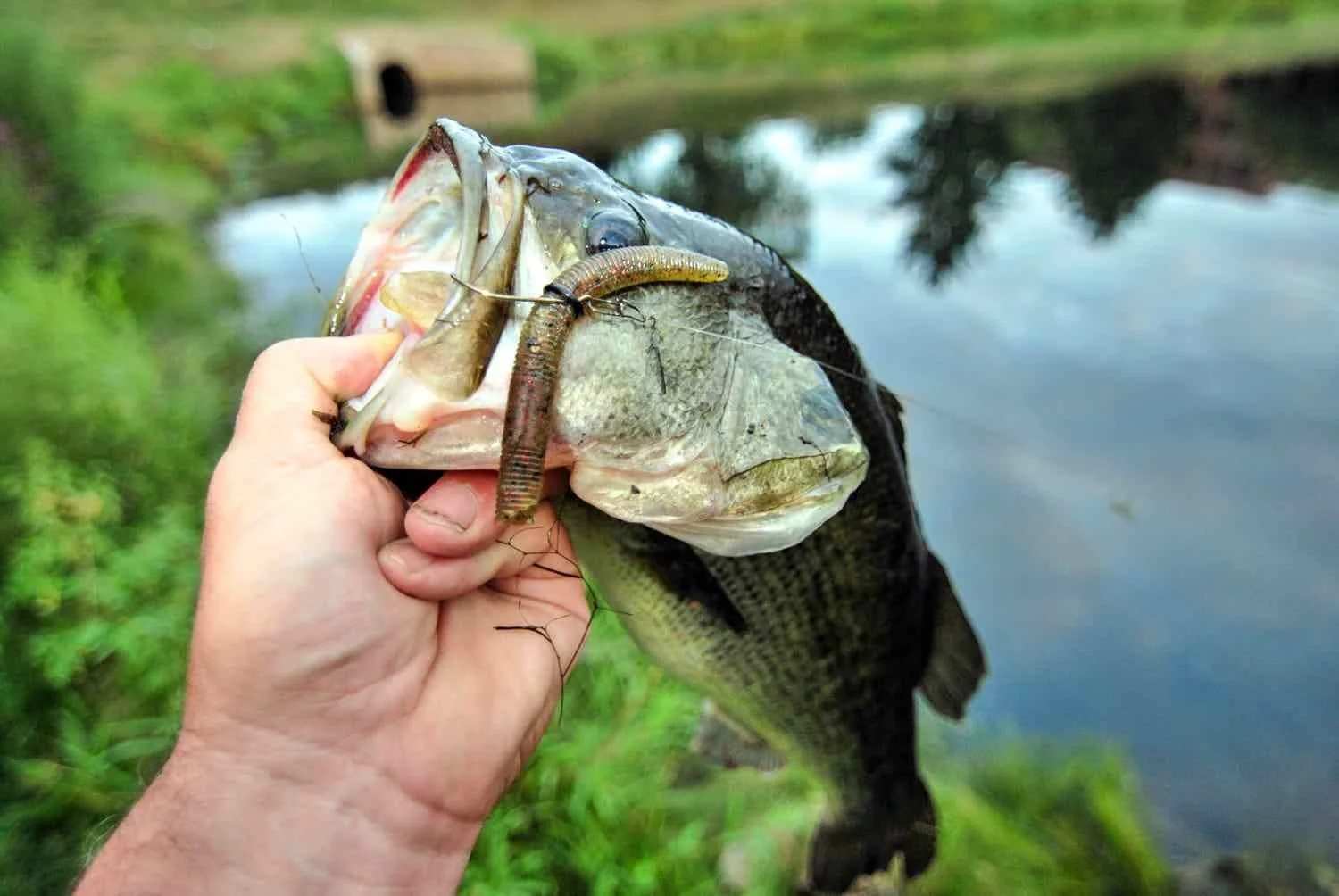
A tiny pool beyond the bridge at the head of the little pond photographed below. I caught the bass in the photograph placed at the beginning of this article on a Chompers Worm here. I don’t know why it’s not letting caption the one below, but just as well. It’s the little pond the tannic content and some weeds. Yes, pickerel, too, from what someone told me when I was there, but all I caught was bass.
A Pond at the Edge of Town and a Tennis Club
The two ponds I can walk to, and the other one where bass fishing took possession of my son, are far from being the only little ponds in plain public sight that doggedly remained productive for years. One spring more than a decade ago, I fished a two-acre pond for a couple of weeks in April, and though I didn’t catch many bass, I caught a few, including a real nice one on an unweighted worm that was the blackest I had caught in years. Even a pond in an ordinary municipal park—such as this one—can have water quality you might expect in more of a wild setting. It’s a dammed stream and has healthy aquatic vegetation. This pond’s water had the tone of black tea. It was tannic because of pine trees in the area. Even though it had a modest-sized spillway, it gave me the feeling of an authentically healthy ecosystem.
I wonder what shape that quarter-acre pond I fished during my teens is in now. A year or two into fishing it, I met someone older than me, who claimed he had caught largemouth bass from Stony Brook nearby and stocked them in that pond only a few years before I began fishing it. I wondered about the bluegills, because many of them were as big as a plate, giving the impression of a healthy ecosystem indeed, an ecosystem that seemed older than a few years, but who knows. The clear water supported healthy vegetation. My bet is that the pond goes on being productive, but I’ll never know, because my days of being a youngster with the audacity to walk onto a private tennis club’s property are over.
You don’t necessarily have fish private ponds. Plenty of publicly available ponds produce, and you might be fortunate to secure permission at private ponds, besides. I’ve read stories of guys knocking on front doors to get permission in Sussex County, New Jersey. And whole panoply of lures and presentations work, though it seems most of the time, you can’t beat a plastic worm.