Anchor in the Wind
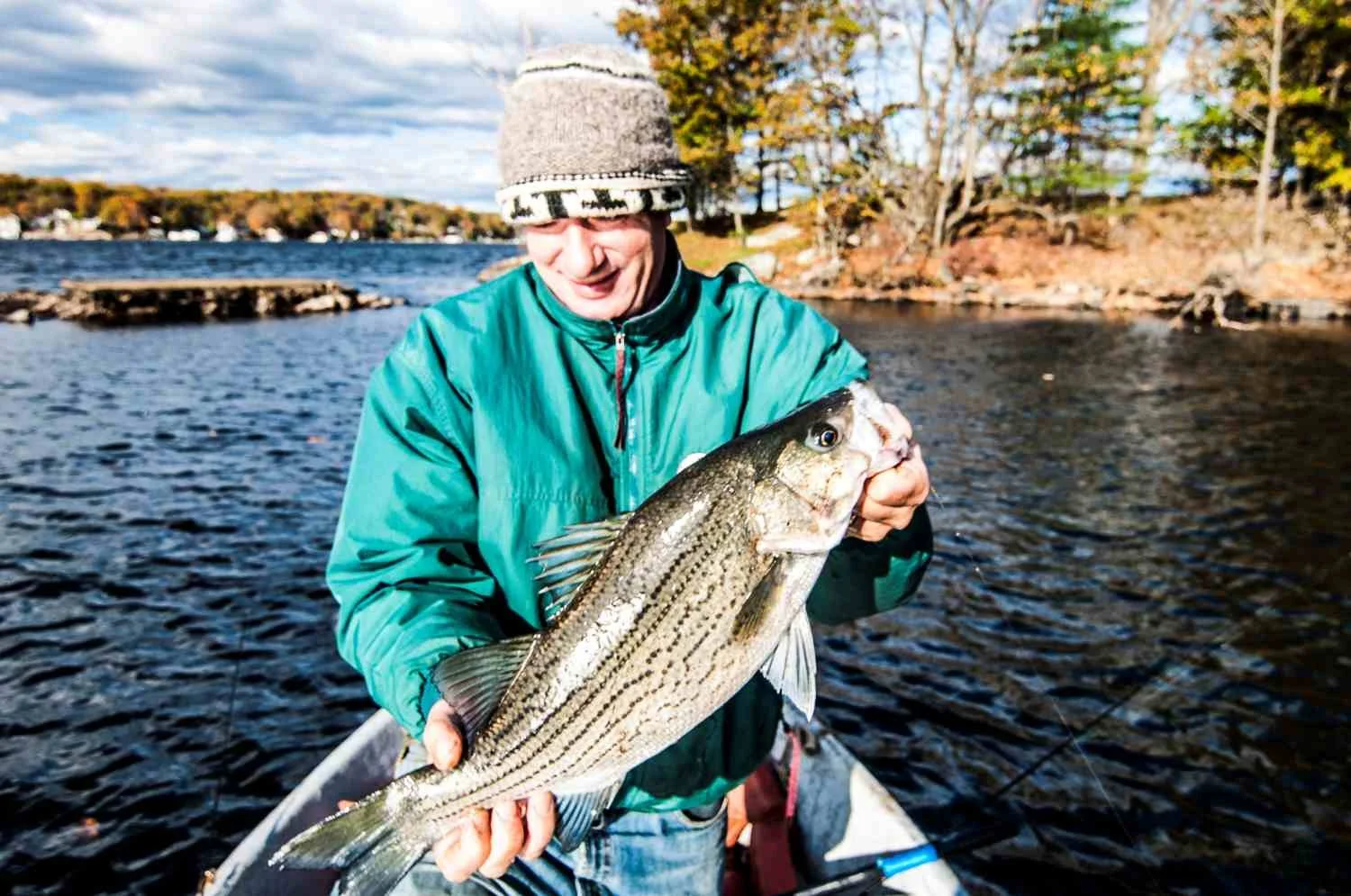
Often the wind is only moderate at best, but that may be enough. On this particular day in October’s third week, my son and I caught hybrids, walleye, largemouth bass, and a smallmouth bass.
That’s the smallmouth bass. I cast right up against a rock face. The bass hit on the drop about two feet down. We used to use nightcrawlers because of course my son—we began fishing there when he was eight—liked them. He moved to California and I began to catch plenty of bass—mostly largemouths—on plastics. To break up the day a little that way, from the walleye/hybrid quest, is the spice of life.
Anticipating the Drop-Offs
I certainly want to publish this one now, while Dow’s Boat Rentals is still selling live herring.
From mid-October into early November, expect walleye and hybrid stripers to position on deep drop-offs, feeding on herring. Lakes and reservoirs to consider include Lake Hopatcong (walleye and hybrid stripers), Spruce Run Reservoir (hybrid stripers), Manasquan Reservoir (hybrid stripers), Monksville Reservoir (walleye), Canistear Reservoir (walleye), and Greenwood and Swartswood lakes (walleye). When water temperatures dip below 50, both species become difficult to catch, although dedicated vertical jiggers score through November and into January until ice makes boating impossible.
All of the large, open waters mentioned are frequented by high winds in the fall. By what I have observed, most anglers clearly seem to consider that a problem. On one occasion while fishing with my son, we motored a long distance from one windy spot on Lake Hopatcong where we had caught many walleye and hybrids, to another windy spot of interest. The steady 30-knot blow with higher gusts made traveling in a small boat rocky. I stopped and asked every angler along the way how many fish they had caught. Every one of them had anchored out of the wind. Not one of them had caught any.
Such is evidence, not proof. It’s probably better to fish under a wind-whipped surface when you can. I had asked around because I felt I could confirm my suspicion that by fishing out of the wind, the others compromised productivity. I remember that one of the spots occupied was Elba Point, a steep drop-off out of wind coming from the north. A popular spot during the fall.
Why Double Anchoring Isn’t Necessary
I tried a method the late Manny Luftglass promulgates in his books. Double anchoring will stabilize a boat in the wind, but I gave up on it because it felt like one complication too many. Anchor from the bow. To anchor solely from the stern in heavy wind will sink a boat because of water over the transom. Let out nearly a hundred feet of anchor line. The anchor will hold bottom that way. The boat swings from side to side but not too widely. It’s best to set lines by casting 3/4-ounce slip sinker rigs, bails kept open, unless instead you use a powerful bowmount electric motor and jig vertically.
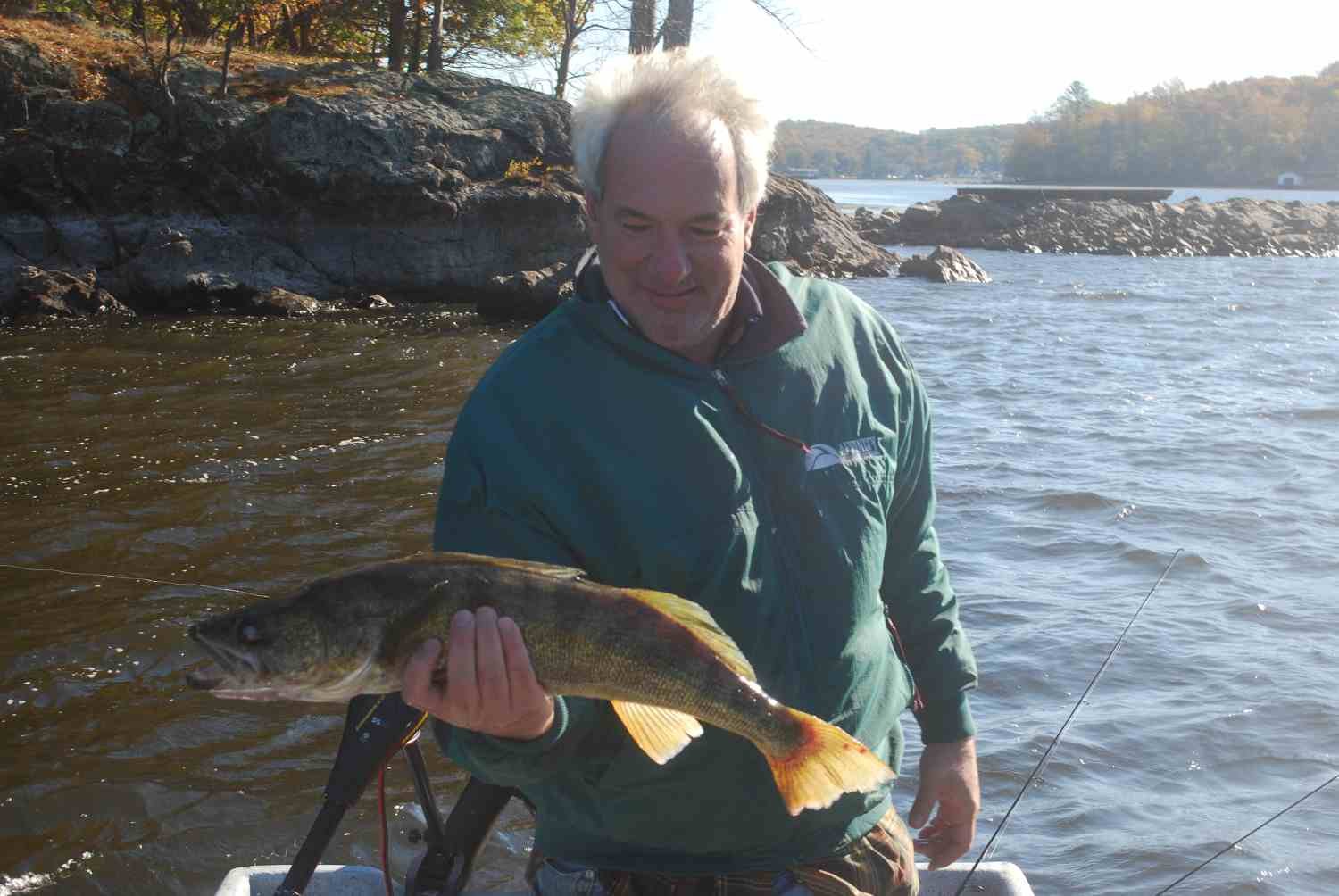
A walleye weighed in at five pounds, 15 ounces. Even when the wind is up, you can anchor on a drop-off close to rocks. Just make sure the boat won’t swing into them. Rocks like that hold bass. Largemouths, too. The drop holds walleye and hybrid stripers.
With six lines out for two in the boat, you would think the quick result would be a tangled mess. Not so. The position of the lines relative to the rods shifts constantly, but by tending them, which doesn’t take too much work, they keep their integrity.
You can’t tell from the photo, but Steve Slota and I began fishing that morning at 28 degrees F. And look at the sky. Everyone says walleye can’t stand the light, but Steve and I caught multiple walleyes that day.
When a hybrid striper takes a live herring, line moves off swiftly; when it’s a walleye, it unravels from a spool slowly. Whichever fish hits, and sometimes it’s a white perch or crappie, it’s important to get any lines close to the live rod out of the way by reeling them in quickly while your partner begins to undergo the struggle with the fish. It’s easy and routine if you space each line far apart from the others to begin with.
Line and Terminal Tackle
Use monofilament or fluorocarbon, not braid. Herring are powerful swimmers, and each size 6 plain shank Mustad hook should be spaced about four feet from the slip sinker by a small barrel swivel. Not too small. The sinker will pass through it. Place the hook’s point through a herring’s nostrils. It is true that a size 10 treble hook will sit like a crown on the herring’s head, while a single-prong hook will turn inward upon an eye and possibly disrupt the bait’s freedom in the water, but trebles swallowed by small fish—like 10-inch hybrids—invalidate them as an ethical choice. Down in depths of 20 to 45 feet, the herring will swim about on that four-foot leash. When you reel in the rig and check on it, you will find a tangled mess if you use braid. No matter that your leader should be fluorocarbon—braid will tangle with it. Six- to 10-pound test leader and mainline will do. Besides trying braid, we’ve always used monofilament for the mainline. Fluorocarbon does sink. Whether that will cause any tangling, I don’t know.
Do herring have the strength to pull line through a slip sinker in excess of the four-foot leeway? Yes, but not by much. With the reel’s bail open, the line isn’t very tight, but the repeated sweeping motion of the boat from side to side tightens the line by pulling the barrel swivel near the slip sinker. And besides, if a lively herring gets a few extra feet of line through the sinker, you shouldn’t complain, because your quarry won’t necessarily swim along the bottom anyway. Most walleyes will swim close to the bottom, though hybrids might easily swim seven feet above. (Or more.) But any walleyes might go out of their way to snatch a herring trying to escape by swimming towards the surface.
These guys, probably vertical jigging, are on a mid-lake hump.
Are the Fish Stimulated by the Surface Commotion?
Now about the choppy surface. Objectively true or not, it’s always seemed to me that a choppy or wavy surface does more to make fish bite than disperse light and make for a darker environment underneath. The way that story goes, fish prefer darker environments over sunlit, so violence at the surface is better than calm water with a lot of light getting into the depths. More than that scenario is involved. Fish have sensitive lateral lines that sense pressure. This sensory organ is subtle. Walleye and hybrid stripers can probably feel a single herring from considerable distance. I don’t know from how far, but I do know lateral lines are a keen sense, because I’ve witnessed a largemouth bass caught by my son on an unweighted plastic worm—subsurface—in muddy water with absolutely zero visibility. From twenty to 45-feet down, it wouldn’t surprise me if walleye and hybrids are well aware of wind commotion above. And I believe such commotion stirs these fish, more or less, into an active mood of feeding. I believe they seek out disturbance, abandoning the calm spots.
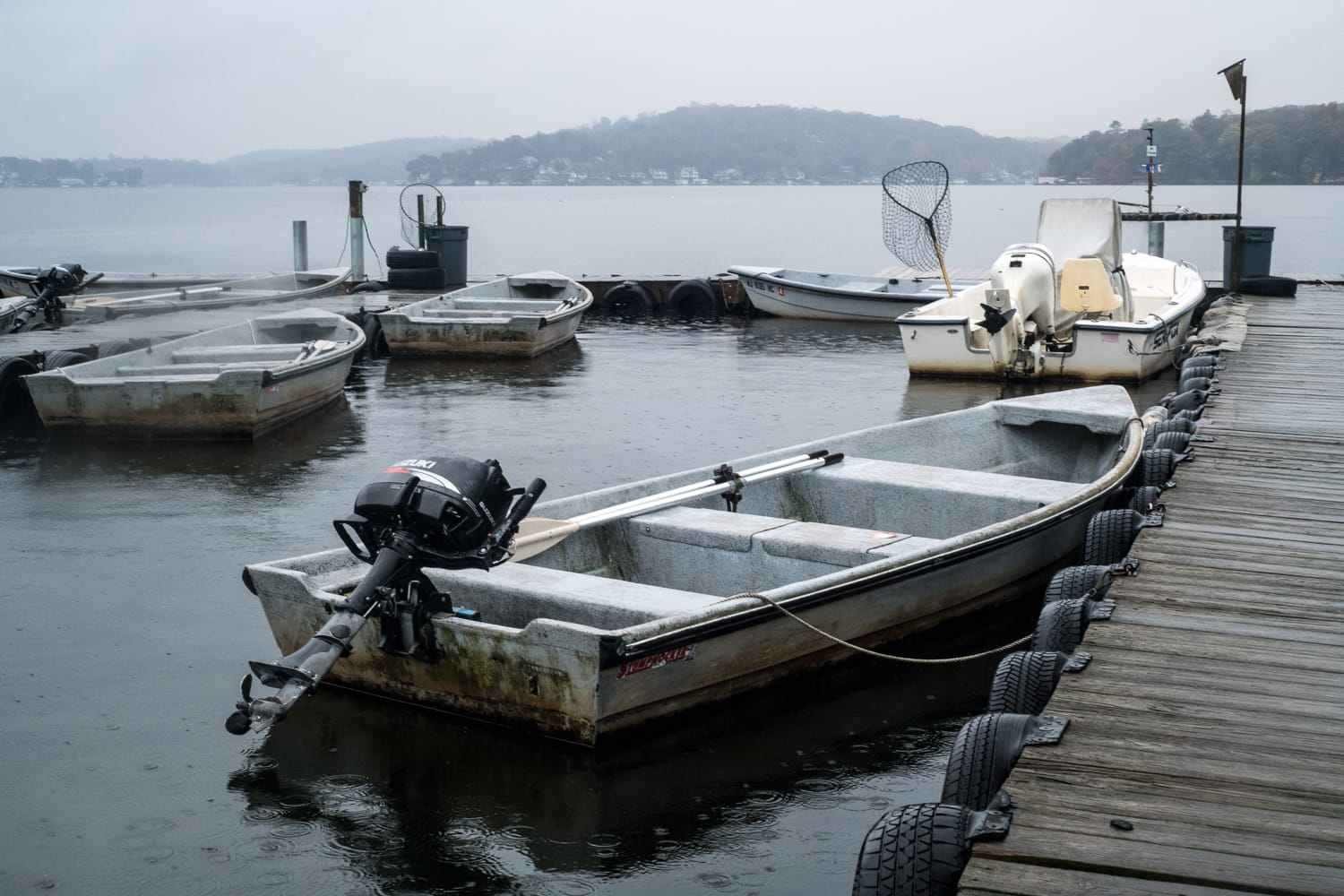
The last we rented from Dow’s Boat Rentals was 9/14/26. They provided the means for me to enjoy some of the best times of my life. I never forget the first time. “There were a couple of six-pound hybrids caught. If you listened to me and fished Sunrise Point, you might have caught some,” Joe Welsh told me. “Next time I’ll go where you recommend.” That next time, same summer, Matt, my son, caught a five-pound walleye. I got to know Joe, Laurie, and Jimmy Welsh well over the years.
Windy day or not, in all of our nearly 20 years of fishing the drops during the fall, we’ve never pulled more than 20 hybrids and walleye over the gunwale during one outing. One might think that given choice drop-offs where dozens of big fish mark on the graph and tasty live morsels are offered them, we would catch a lot more fish than we do. The typical outing results in only three or four, though they are good-sized with walleye averaging about four pounds and hybrids about three. I never have understood why the fish aren’t more willing to hit, but I do expect better action when the wind is up. From mid-October into November.
Liver
Whether or not the day is windy, we’ve tried chumming the fish with liver cat food and have dangled chicken livers in front of the noses of what clearly seem to be schooling hybrids, but it makes no difference. The only exception I’ve actually witnessed was Lake Hopatcong regular Marty Roberts as he finished pulling many dozens of hybrids from 29 feet of October water on live herring while he chummed liver cat food. (His live well was loaded with bait.) Most of his bass were two to three pounds, although he did catch some five-pounders. I’ve heard insane stories of catches like that of Marty’s involving chicken liver bait.
The article’s original is with New Jersey Federated Sportsmen’s News.
A grainy image I might replace with one I’ve denoised. It’s the full moon rising. I’m sure my favicon, the Wolf, is letting it all out.