Sandy Hook Fishing
I didn’t catch this fluke on Sandy Hook, but nearby, in the Shrewsbury River, and it’s a recent catch, from September 24, 2026, one day before the close of New Jersey’s fluke season.
An Outing at the End of the New Jersey Fluke Season
I had meant to go for fluke back around the end of August, but other things got in the way, and then I had a spinal stenotic flareup on Monday, September 7th. As I write at the very end of September and will finish writing on October 1st, my back is still giving me trouble. I’ve started to think seriously of going into physical therapy, and I know some of you would tell me I must. I might. It’s more time to invest, though.
Speaking of which, I did get out on Thursday a week ago—alone—and fished the Shrewsbury River on foot. (The Shrewsbury flows directly into Sandy Hook Bay.) I won’t give away my spot. It was bequeathed me by someone who moved to Florida. I never got a chance to fish with him, though I watched him closely on Facebook—he’s a great angler—but I might fish with him yet, as I still want to go fishing in Florida with some of my friends.
There’s a lot of spots to fish by foot along the Shrewsbury.
I began by fishing rock-studded deep water with a 3/4-ounce leadhead jig. The incoming tidal flow was so heavy with the nor’easter’s winds pushing it in, that I gave up on that jig drifting like a salmon egg. I didn’t have a lot of time, but I had enough time to text my friend in Florida. He phoned me, mentioning sand as we talked. That was the exact clue I needed, besides switching out my heavy leadhead for a quarter ounce, my own idea, which proved to be perfect for a protected spot … with a sandy bottom.
For certain, reaching out to someone who can inform you is just the thing to do sometimes.
I felt the jaws snap, paused for the slightest moment of disbelief but knowing it was a fish, and set the hook. The fish fought hard. I got it on land, fearing it would be 17 ½ inches. I felt surprised it measured 19 1/2.
That fish served as dinner, a pretty big dinner, for my wife and I. Delicious.
Sandy Hook, photographed from the ridge over the Atlantic Highlands community.
Six Miles of Fishing Opportunities
Most of the opportunities are from ocean beaches, but Sandy Hook Bay is accessible in many places. At the very beginning of Gateway National Recreation Area, it’s questionable whether you’re fishing Sandy Hook Bay, or the Shrewsbury River. I would say at Plum Island, you’re at the mouth of the river where it becomes the bay, but you can park inside the Recreation Area, and fish on foot north of where the island gives you access to a lot of good fishing. My son and I once fished with his Uncle Jim where it remains river, and we caught bluefish, even though, on that day, the incoming tide rose especially high, carrying with it a lot of cabbage that got on the hooks.
The bridge over the Shrewsbury River taking you to Sandy Hook. It’s definitely a river here. It used to empty into the Atlantic. The Shrewsbury Inlet achieved permanent closure on July 8, 1848, after a steamboat wreck accelerated the buildup of sand. Railroad construction in 1856 completely sealed it.
The new Shrewsbury River Bridge, photographed on May 15, 2011, after it opened on May 1, 2011. I stood on Plum Island with my camera.
Jim Purdon wades from Plum Island at the mouth of the Shrewsbury River and beginning of Sandy Hook Bay.
Fluke Along the Hook
Sandy Hook is a popular summer destination, whether from the surf, from the bayside, or from boats. A couple of decades ago, a friend used to tell me about renting a wooden boat with friends from Atlantic Highlands. It didn’t cost much, and they caught fluke. I didn’t find anything like that, searching the web yesterday. I can tell you, though. If you don’t own a boat, and you don’t want to rent one at an outrageous price, fish the surf, fish the bay in close—and don’t give up. Besides, you need a boater safety certificate these days, on top of rental rates.
The fluke fishing can be quite good by walking and wading, with 30-fish catches not uncommon. The catch is obvious, once you become informed on these things. It’s that, most likely, not one of the 30 fluke will be a keeper. Keepers do get caught on fairly common occasion, though. Fish as large as five pounds, though big ones like that don’t come to hand frequently.
I used to love to catch fluke on killies—catches that included keepers. On one occasion, going on two decades ago, I didn’t know I fished the nude beach—until I looked. I kept on fishing my killies, and I caught an 18-inch keeper fluke and two nice-sized bluefish, each over two pounds, maybe a little longer than 18 inches and chunky. I used the 5 1/2-foot St. Croix, medium power, that I still use in freshwater to this day, having bought it in the year 2000. A large split-shot served as the weight. I also used my eight-foot Tica, catching the blues on that, but with the surf calm, I caught dinner in close on the light tackle.
Nowadays, I jig ‘em. Gulp! twisters and Jerk Shads, Elaztech, Fish Bites. I don’t stay with one “hot” brand. That way, I get a sense of the possibilities different baits offer to meet the requirements of various situations with lots of overlap, I’m sure. I also change up the jig heads, but I always use a teaser. Fluke often go for the teaser.
I’ve been told by a top-notch angler that big fluke will be on rocks if they can find them. This one isn’t particularly big, though a keeper, and caught in the surf of North Beach. I have found, in the Shrewsbury River, that although rocks are worth fishing, sandy spots will have fluke on them. I lack experience.
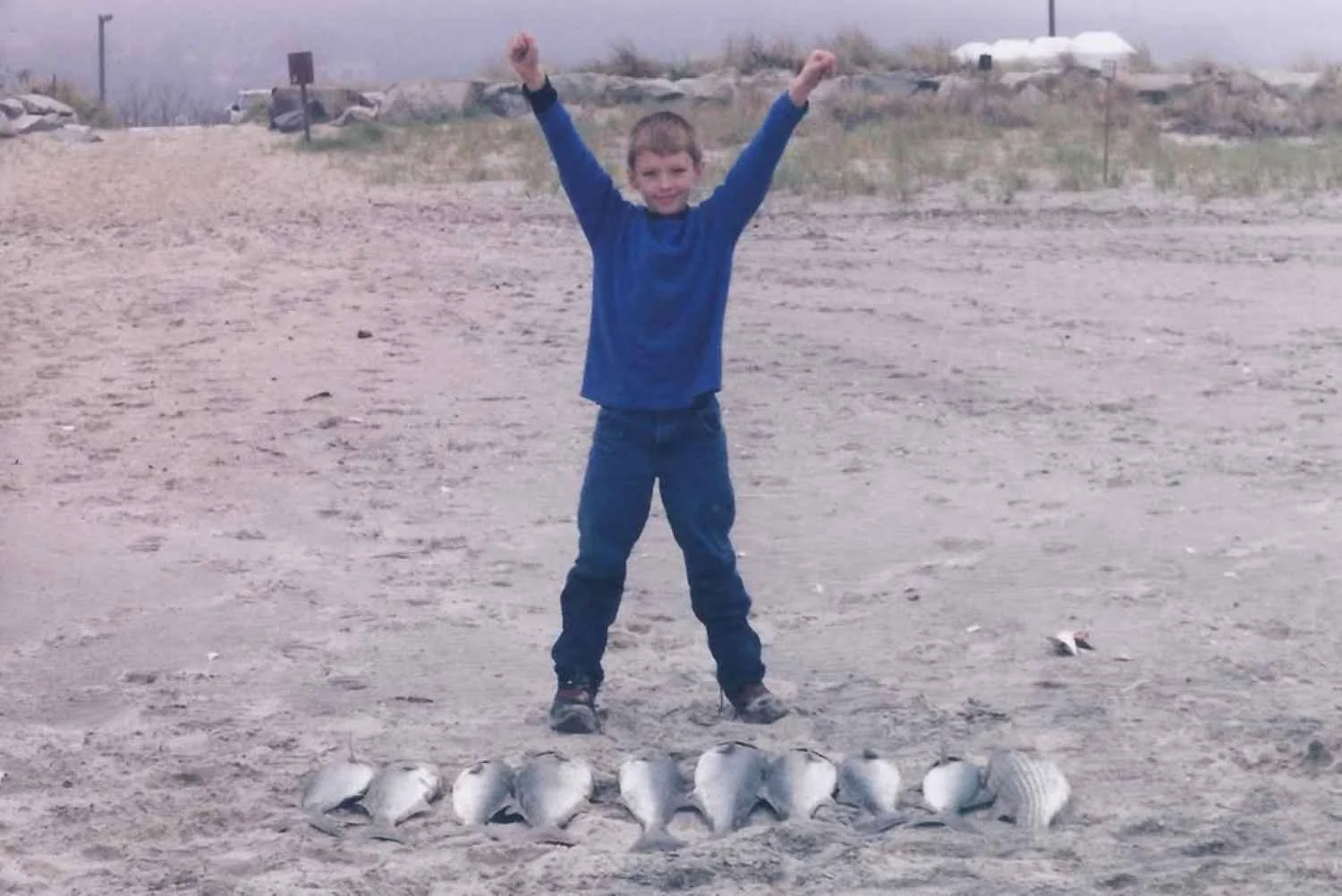
My son, Matt, and I fished a beach up near the entrance to the Recreation Area, catching a lot of nice blues. On the right of the line of fish—this happened before bluefish regulations changed—you can make out the striper he caught.
Surf
During the summer, in addition to fluke, croakers and kingfish get caught. A hi-lo rig might be best, and various baits like shrimp, squid, and Fish Bites bloodworms. Late in the summer, the pelagics—false albacore, Atlantic bonito, Spanish mackerel—will occasionally enter the surf and get caught on epoxies and metals. Boats chase these fish out there in the beyond.
During the spring and fall, a lot of stripers get caught, and sometimes sizeable bluefish. A wide panoply of lues tailored to specific situations catch both species, but if you’re new to fishing the surf, I recommend you use either clam or fresh bunker on a fish finder rig. Begin with a Gamakatsu circle hook of about size 8/0. If you’re after blues, snap it on to a 30-pound test wire leader. Just make sure that leader is about 18 inches long, and that it’s one the tackle shop proprietor either would or does recommend to you honestly. I know how to look and make sure, you might too, but my brain is struggling to describe what I see to you. It’s the snap. If that snap comes undone, you’re screwed.
I once lost a nice pike in the Passaic River to an inferior wire leader snap. Ask the proprietor about strength, too. You can mention that I once had a bluefish pop a 30-pound test wire leader at the swivel. Happened at Plum Island during May long ago, and it is true—that was a big bluefish that ran, slowed, ran, slowed, ran, slowed, ran—! But I’ve always felt that leader should not have given. The fish was not an accidental cow striper. I know how a blue runs and how a striper runs. Use fresh bunker chunks for blues.
And if you’re after stripers, use 30-pound test fluorocarbon leader about three long. Thirty-pound test ought to hold a really big bass, but if you can tie a clinch knot with 40-pound test that isn’t compromised by not lining up neatly—use that. Tie that to a barrel swivel of at least 50-pound test, attach a sinker sleeve to your mainline, tie that mainline to the barrel swivel and attach a pyramid sinker to the sleeve.
Now, about the mainline. Use 40-pound test braid. Don’t use monofilament, as 40-pound mono means you won’t cast as far. If you use, say, 16-pound mono, you might break off a big bass, as I once did that way in the years before I began blogging, and even with 40-pound braid … make sure the drag is set at 1/3rd breaking strength, and make sure you tie a good knot! I use a uni knot. You can’t use the same knots you’ll use for mono and flouro, not with braid. Stripers will take bunker chunks, but fresh clam is usually the better bait for them. It might be true, though, that fresh bunker heads are better for especially big bass than fresh clam. Something to keep in mind if you have reason to think cows are in the surf.
About braid, just yesterday I got an email message from Traditions Media about Daiwa’s new Xbraid. It’s expensive, and personally, I don’t see myself swapping out the Power Pro braid I’ve been using, but that’s nothing against Daiwa’s quality. I must’ve read what amount to a couple of pages of fairly technical writing, and if I find the braid I’m using gets frayed, I’ll return to considering Xbraid again. And if I do, you’ll probably hear about, if you follow this blog.
It’s a good idea—when you have time—to look into such things.
That’s a good-sized striper caught in Raritan Bay caught on half a live bloodworm in May . Bloodworms have always been expensive. I used to buy them at Kitty Hawk Pier, North Carolina. They seem more expensive today, because prices rise. I’m not saying prices necessarily rise justly, though. But in this case, I think I remember from 1984—could have been longer ago—a price of over six dollars a dozen. Oliver Round told me he paid twenty dollars a dozen, this past May.
Neighboring Raritan Bay
Beyond Sandy Hook Bay is Raritan Bay, known for great stripers caught from boats in the spring. But Raritan Bay offers the shore bound angler spots where he can catch some great stripers, too, and when weakfish are around, they’re available from shore or from wading, too. It might be easier to catch stripers from a boat, and given time constraints, possibly it’s the only way you’ll catch a really nice one, but if you persist on foot, you might do it.
Raritan Bay offers you five free fishing piers. Fish get caught from them. Also, the Keansburg Pier offers its services at a reasonable price.