Polishing Bronze
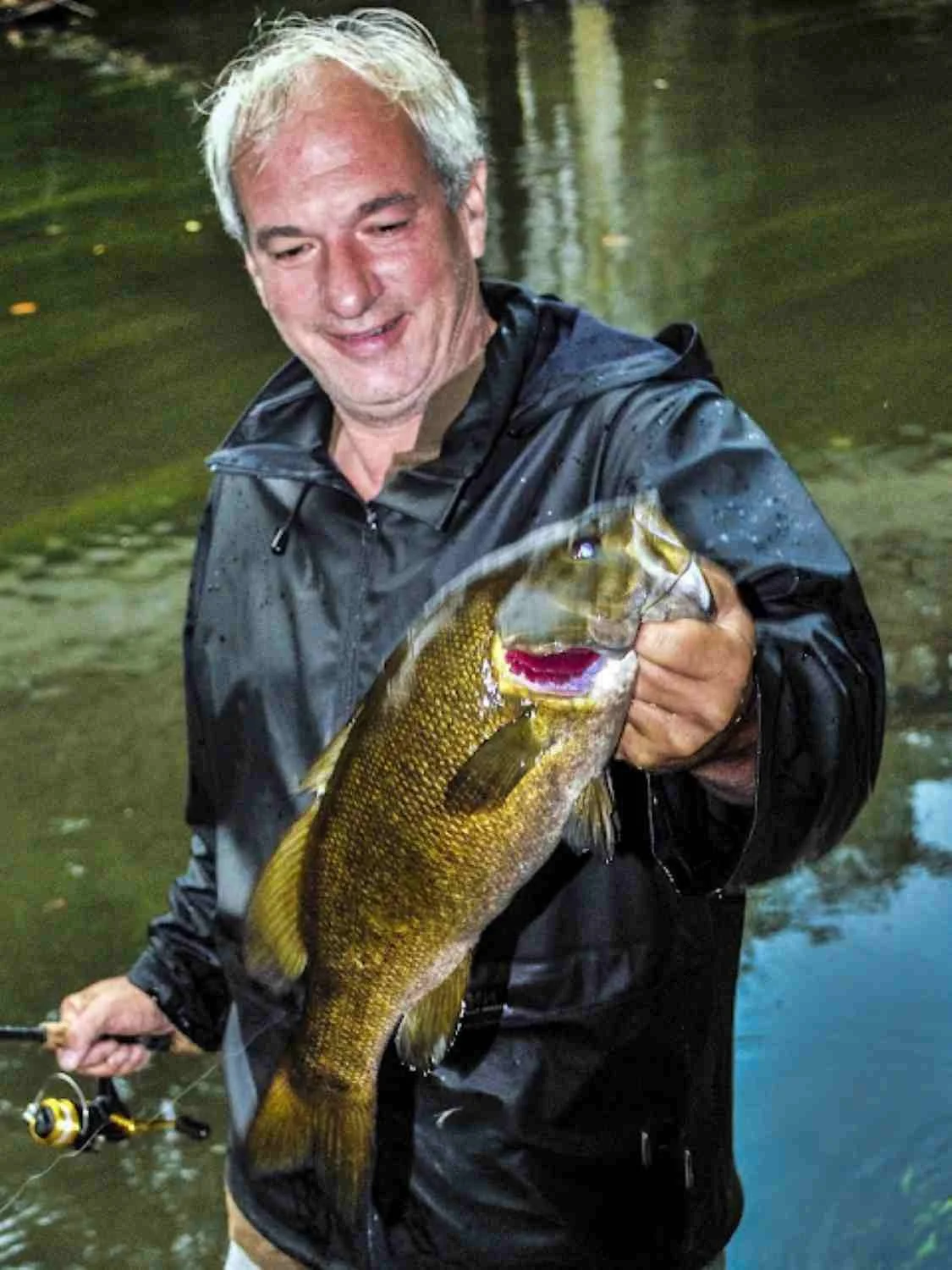
That’s my best smallmouth so far, and though I didn’t weigh it, at 19 3/8ths inches, I doubt very much it was four pounds.
Smallmouths Thought Scarcer than They Are
New Jersey’s smallmouth bass fishery is a shadowy affair compared to that of largemouth and trout. The old Lake Survey Fishing Maps Guide, for example, rates the presence of largemouth in Lake Hopatcong as “1” or “very good,” but the “fair” showing of smallmouths getting a “3” on the scale of 1 to 4, with “4” being “poor or absent,” might leave you wondering why. Go after them on Hopatcong, and you may find they’re quite common around the many rock and wooden structures. I do know of two other fisheries where a “3” might be appropriate for the species, however.
Saffin Pond in Mahlon Dickerson Preserve, Morris County, is only 12 acres, the smallest body of water I know in New Jersey holding a reproducing population of smallmouths. I’ve caught two of them. I don’t say the fishery is poor, because I might do better by sticking to the rocks. I do believe smallmouths are more elusive in Tilcon Lake, where I’ve fished since 2009 and have caught only two, my son having caught another, and yet I’ve heard about them from other anglers. So, I also balk at calling that fishery poor.
Matt Litton with a good one nearly 18 1/2-inches long from Lake Hopatcong.
Loaded Fisheries
Other waters are loaded, though. The Newark Watershed, Round Valley, Merrill Creek, Split Rock, and Spruce Run reservoirs, Manasquan Reservoir has a good population, too, as well as Union Lake deep in South Jersey. At least, last I heard Union was good. Little Swartswood and Aeroflex lakes reportedly have smallmouths, but I can’t say from personal experience, though I’ve caught fish from both of them.
Not a bad bass from the South Branch Raritan.
None of that is to mention the abundant populations in the Raritan River system, Musconetcong, Pequest, and Paulinskill rivers, and the Delaware. Many anglers have never believed they’re as common as they remain elsewhere than Stony Brook. It’s that syndrome of a belief in scarcity, which gives Lake Hopatcong a 3.
A Couple of Expired Fisheries
Growing up in Mercer County, I caught plenty of different gamefish species locally, even though, reading the reports in The New Jersey Fisherman, I felt the Highlands had the best action. I still believe that best action is here, but I caught over a thousand smallmouths from Princeton Township’s Stony Brook. I told a friend about the action, and he skewered me for my lack of knowledge, exclaiming, “They’re not smallmouths, they’re just brown bass!” I’ve never heard a more perfect expression of the denial I’m getting at. As if the bronzeback bass only gets caught in faraway places like Minnesota. To have thought Mercer County was loaded with them was as ridiculous as believing the Princeton Ridge is studded with diamonds for the taking. But Mercer County was absolutely loaded with them. Beden’s Brook had them, too, though the ecologies are delicate. More lawns mean fewer fish, as my brother Rick and I believe is why the bass have disappeared as if they never existed. I’m sure most local fishermen believe they never were there.
Whether or not smallmouths still occupy Beden’s Brook, I’m not certain. But I fished Stony in 2011 and got skunked. Shortly after that, my brother Rick fished an entire half-mile stretch up and down, which normally would have produced for him in the double figures. Skunked.
Pennsylvania’s Lehigh River is an excellent smallmouth stream, near the Delaware River at Phillipsburg, New Jersey.
Disbelief
Even in the Highlands, where some anglers regularly catch smallmouths, fishermen don’t believe in them with the unambiguous knowledge associated with largemouth and trout. Social media posts do eliminate the mystery for many, but deep-seated denials persist in the face of evidence. Besides, even if the existence of the species is fully accepted, the smallmouth bass is regarded a minor species compared to the largemouth, because of the smaller mouth, smaller size, and even the darker coloration. After all, the mouth of a five-pound largemouth is an impressive thing to grasp, but along with its minor status, the bronzeback is also regarded, paradoxically enough, as more of a prize catch than a largemouth, and that’s partly why fishermen in New Jersey have a problem with them … as if our state doesn’t deserve prize catches having that indefinable quality of special value. I understand you can go to Minnesota and relish the adventure, but why not accept New Jersey as just as valid a place on Earth?
Questionable status does protect smallmouths somewhat from the omnipresent urgers of anglers. A largemouth is an easier target to approach, because everyone goes after them with no compunctions. In Highlands rivers, where catching 50 smallmouths in one day of fishing is possible, thousands of anglers pursue trout in the spring and fall, while only a handful go after bass. Sections of the rivers are accessible only by float trips, which raises the bar on what’s worthwhile. In 2024, Brenden Kuprel and I attempted to access a stretch of the lower South Branch by wading before sunrise, temperatures comfortably in the low 70’s. We never got close to the goal, because water got deep, but after persisting through the difficulty and danger of wading perhaps a quarter mile upstream, I came upon a big stretch, while Brenden fished a narrow reach downstream. Already feeling fulfilled, because I knew bass were possible, I cast a Baby Torpedo, which yielded a 10-incher. When Brenden caught up to me a couple minutes later, rain began to fall. Nothing had felt better all through the work week, and having caught a single bass helped confirm an effort that taught me more about a river I want to know better.
River bronze supposedly fights harder than that caught in reservoirs and lakes, which I believed while growing up. By swimming against the current, the fish exercise, and I’ve tested them by catching them in both rivers and still water. Those I catch in Lake Hopatcong seem to fight just as hard. I’ve never heard of any proof either way, but it’s self-evident that they fight harder than largemouth.
Matt Litton travels down the Delaware with Sadie the black Labrador. He always caught a lot of smallmouths on these floats near Barryville, New York.
River or still water, smallmouth bass relate to rocky and wooden structure. Or they suspend over depths near rock and/or woody structure. Lake Hopatcong is anoxic deeper than about 18 feet during the summer, and Spruce Run Reservoir has the same problem. In October, the depths become oxygenated, and smallmouths will stage among rocks whether deep or shallow. I once caught a nice one on Halloween from Hopatcong among rocks two feet deep.
Experience teaches anyone who’s caught a lot of both species that smallmouths are the more aggressive, apt to respond to lures throughout the day. I’m not the only river angler who testifies to productive 95-degree afternoons, and I’ve done well on Hopatcong under hot noontime sun, too.
It is true, though, that like other gamefish, smallmouths will especially turn on when a low-pressure system approaches. My son and I know a spot on Hopatcong that always produces on a summer day, and though action is usually slow, the bass are big. On one occasion, clouds indicated an approaching front, and we heard thunder. Bass after bass got caught until we safely fled to shelter at Dow’s Boat Rental.
Events like that suggest many bass exist in a lake that usually feels forbidding. They’re pressured fish, whether aggressive smallmouths or laid back largies, but when they lose that inhibition, they reveal their abundance. The degree of resistance on a normal day is the challenge you outsmart if you catch a few. It’s a problem during the fall too, even though bass are chasing forage. But whether you fish a lake, reservoir, or river, keep your presentations close to the rocks and you can hammer bronze.
The article’s original was published by New Jersey Federated Sportsmen’s News.