Shallows Warmer than the Water Over Depths
My largemouth bass from relative shallows at the back of the lake. I took the lake’s water temp at 56 here where it was warmer, whereas it was 50 at the surface either near or over deep water.
Temperature at 50 Over Depths
I got out and fished relative shallows with Brian Cronk, and though I took the lake’s temperature only twice, that would prove to be telling. I know I took the first temperature at least near deep water, but it might have been at the surface over deep water itself. In any event, Lake Aeroflex is a deep lake at 110 feet maximum. At first, I believed shallow flats were overrun by water moved from over depths by a brisk wind, rather than warmed by sunlight absorbed by the bottom. I had fears the water wouldn’t even be 50, owing to that depth, and though the air was hardly over 50 when we got there, I wanted to be there fishing in any case.
Trolling
I think of the water in the front almost as a second lake. It’s separated from the main lake by shallows, a bar that goes all the way across. Beyond that bar—aiming towards the lake’s rear—the lake is 110 feet deep, depths of about 90 feet existing besides. It’s a natural lake, so it’s not as if quarry blasting had created those depths.
We began trolling almost as soon as we motored off by use of Brian’s electric. We did a full circle,, skirting the edge of shallows about 10 feet deep, hoping to hook a trout we would have to release. Each of us used an eighth-ounce Phoebe.
Casting
We cast a section of shoreline, about a hundred feet long, related to that bar I mentioned. Brian had done well here years ago when fishing in my “tippy” canoe. He caught a lot of pickerel that time out on jerkbaits.
I also cast the shallows of that bar with a Mepp’s Aglia Long. I didn’t get a temperature specific to it, but I believe it was more like 50 than an additional six degrees. Not a hit.
The writer with the pickerel he caught on a fat worm.
Yum Dinger or Shim-E-Stick
One or the other. I have packs of both Dingers and Shim-E-Sticks in my bag and can’t tell the difference. (They’re like Senkos.) We started making our way down along the shoreline opposite to Limecrest Road. I cast the worm persistently. I don’t remember what Brian cast.
I did have the feeling nothing was going to happen, but I fished as if something would. Pushed along by the wind, we had neared the bottleneck that leads boaters into the back of the lake. I was working the worm back to the boat when I set the hook automatically, my not having consciously felt the resistance I reacted to. I lifted a pickerel of 16 or 17 inches over the gunwale.
Just beyond the bottleneck, the writer caught a pickerel of about 18 inches on the Mepps Aglia Long.
I switched back to the Mepps and fished the shallows of a residual weed bed to the left of the bottleneck we approached. I fished the same as the wind carried us through. And then I fished it on other side, among more shallows, hooking and landing a pickerel of about 18 inches.
I did have to use pliers to remove the treble hook, which threatened a gill raker. I always regret such as situation as if it might not go well, but once I get to work, I feel good, as if I could have been a surgeon.
And…I judged the final result of my work as safe to go back into the lake. If it were botched, Trish, my wife, is always asking me if brought fish home.
Brian Cronk with a largemouth caught on a Mepps double-bladed spinner.
Back of the Lake
I don’t know what moved me to check the temperature again, but I’m glad I did. Of course I was aware—but on some level—that shallows with dark stuff under clear water warm because that darkness absorbs sunlight. I just wasn’t thinking, absorbed in the fishing itself, but something in me did enough thinking to prompt me to put that thermometer in the water.
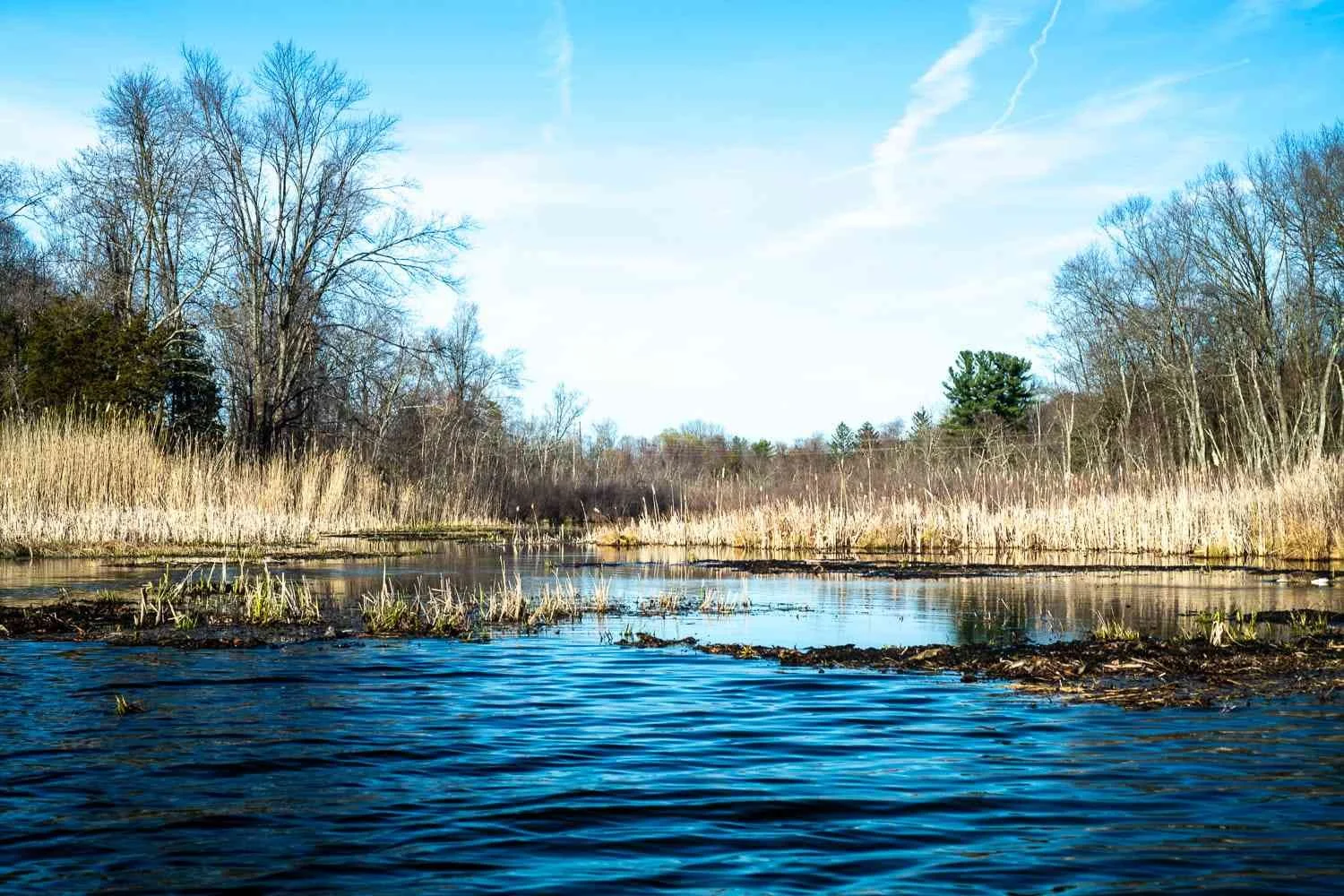
You can see some of the dark thick stuff absorbing sunshine and creating warmth. There are a lot of lily pad tubers already turned green and growing, too.
It was 56.4. Significantly warmer than 50. And the action we had reflected the difference. I got the bass in the photograph at the head of the article, and Brian got the one in photograph here. On his next cast or maybe two or three afterwards, he hooked what I think was the biggest fish of the outing. I was messing with something and not at the net right away, but the way that fish tore by the boat, it wasn’t ready to be netted, anyway.
It tore right off the hook.
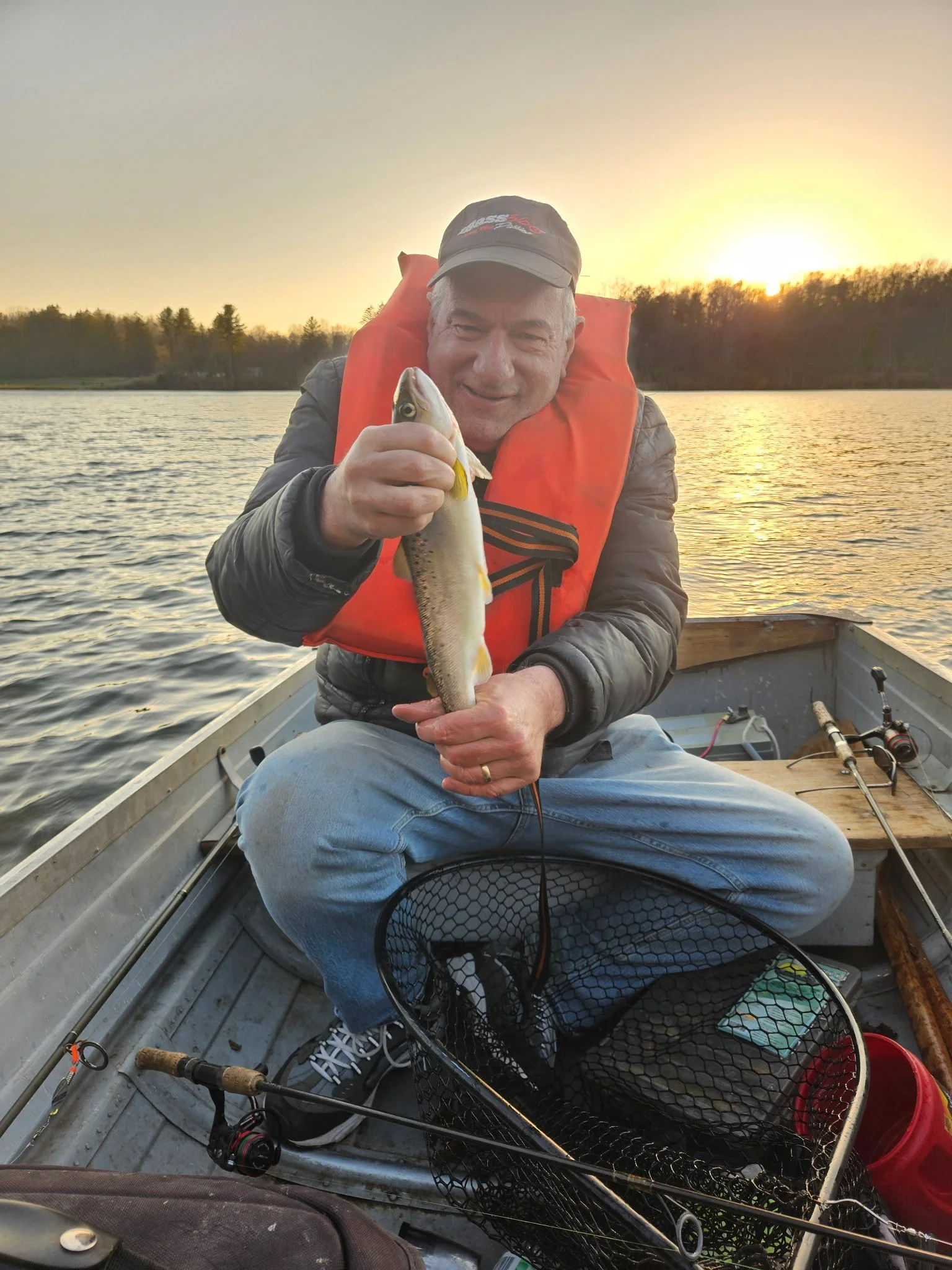
Unfortunately, one of the two eighth-ounce Phoebes I had got stuck in Brian’s net, and I ended up breaking off one or two tines from the treble by use of my pliers. Not that I don’t have a treble on my desk upstairs—in a box full of them, all sizes—to replace it with by use of split ring pliers, but that Brian hadn’t one to troll now. I was going to be selfish and use the one in good shape. It’s always something when you take your advantage. . .only to regret it later. But I have to say, catching the salmon—right about where Brian had caught so many pickerel when he used my canoe—was interesting. Got it back in the water swiftly.
On the Way Back
I caught the salmon. Said about enough in the photo caption. I think Brian got a pretty good shot with the golden sunset behind it.