Expect a Short Period of Topwater Fishing Action
Brian Cronk with a nice pickerel he caught just before sunset, when, very often, an intense period of feeding lasts perhaps 20 minutes.
Twenty Minutes of Intense Action
Stop and think how quickly the bite when fishing around sunrise or sunset comes and goes, and you’ll find most of the largemouths and pickerel caught, and the biggest, come in about 20 minutes of intense action.
I haven’t noticed the phenomena as much during the morning, because I do most of my summer topwater fishing in the evening, but I’ve witnessed it early many times. Mostly, it’s largemouth bass, but pickerel, too. No external signs indicate when the bite begins, such as the moment the sun sets or some fixed amount of time before or after. We catch two or three and probably miss some hits, becoming suddenly aware that the bite is on, and I try then not to fiddle with my camera for long. It might happen before sunset; it might happen later. Usually, the water has to calm.
I began noticing it when fishing Lake Musconetcong with my son years ago. Getting home from work after 5:00, I drove us to Stanhope Bait & Boat before the shop closed at 6:00, renting a rowboat. They only required that we secure it at the dock upon leaving after dark. They levied no restrictions against us about getting in late. I hated to see that shop close, but I understand things change rather than get lost. I was one of the very last—if not the last—to rent a boat with a five-horsepower outboard from the shop in 2005. The next year—due to the abundant vegetation—they allowed rowing only unless you were to bring your own battery and electric motor. And to that effect, my son and I didn’t hesitate to row. Many of these quick adventures played out in September. We then fished for two hours at most, catching a dozen or so bass and pickerel. July and August—the same phenomena came alive, but we had more time altogether at the game, always catching our fish from near sunset until after sunset. Once we caught over 20 bass.
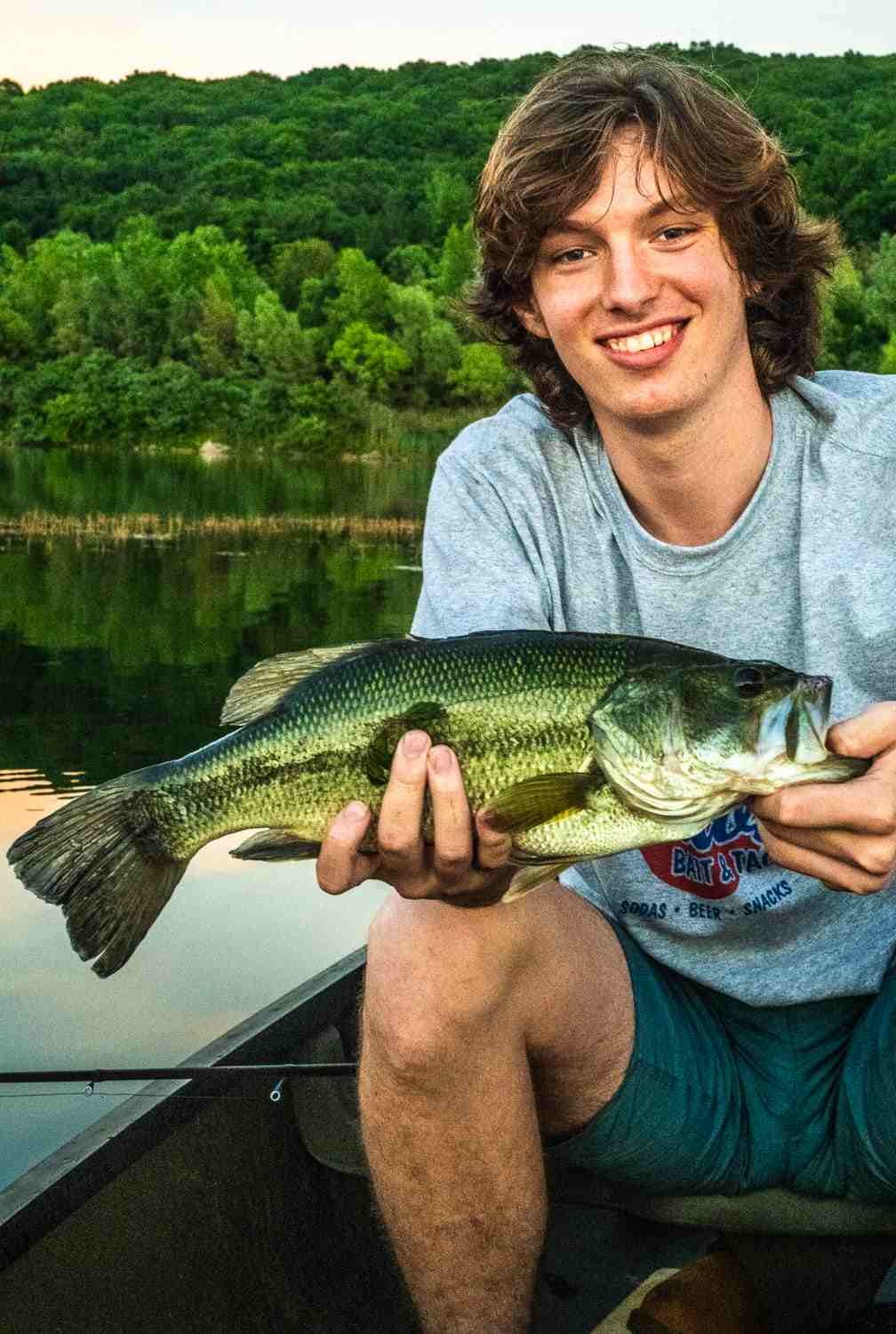
The writer with his best bass from Mountain Lake, the photo snapped by Mike Maxwell with no more time to spare.
An Example of Some Quick Action
A striking example of quick action follows. Action like it might not last 20 minutes, and it might not consist of large numbers, but it’s in striking contrast to the rest of the outing. Two years ago, I promised Mike Maxwell we would catch some nice bass at Mountain Lake. Mind you, I had never fished there before. I knew I risked not being true to my word, and I really meant that word, but because my fish sense told me it would happen—and I can be vocal about that fish sense—I told him so regardless of the risk.
We fished for seven hours, catching three bass, none over a pound, before Mike put his rod down and tried no more. The man can fish, but he gives no more than he thinks might reward him, a conservative and reasonable approach. The onus lay entirely on me to prove my point. On this June evening after blazing afternoon heat, he sat back to relax. He could have felt it entertaining at my expense but clearly didn’t. He was done.
The sun set, and I kept thinking about how to seal the deal. I had said we would catch nice bass, so any of mine would stand in for his as well, so long as they were nice fish. I guess you could say I was thinking crazy thoughts. I fished over weeds with a topwater plug, but the edge of those weeds defined a sharp drop-off close to shore, and I felt sure nothing would happen there.
So … where to? A fiery signal hit my brain that struck a light from the same pack of matches I opened when I invited Mike. Uh, hah. Now I was a believer again. Some would say a fool. How in hell can you tell you’ll catch bass from within your damned feelings? Well, one learns about that external world through experience, so one does gain knowledge.
I switched the electric into high gear, turning the canoe and clocking it back to the lake’s eastern flat. We had already fished among the weeds there, getting nothing but an empty feeling about them. Not an evaluation to bet on now, it would seem.
In 10 minute’s time, I caught three bass on a Rebel Pop-R: one nearly four pounds, two-and-a-half, and nearly two. Not another hit thereafter. After five more minutes, I knew the gig was up and swung the bow around towards the ramp where Mike wanted to be.
He had never picked up his rod and given those fish a shot. I can only assume he knew better. Once he resolved to fish no more, he wasn’t going back on his word, and I fully respect that. My only refusal was to kowtow to his desire to head to the ramp rather than back to those shallows. And when bass seem easy to catch, it’s usually because of a lot of prep work at the particular game played prior to the performance. As much as I knew I had bass to catch, he didn’t know the same for himself. Call it taking the cue from feeling, but I take my feelings from the real world out there, too.
A fisherman stands in relation to reality. His feelings are no less pulled from the world out there than his ideas. We internalize, and that way we make our ability to address the situation all the better and more refined.
Inner Responses Lead to Fish
It’s all about the external world fished, but ultimately, inner responses lead the way to fish. (They’re responses to that real world.) An angler gets so accustomed to finding fish, it’s almost as if he can smell where they await him. I didn’t cast that Rebel Pop-R randomly. The fish actively fed, but they had to be teased out. But for any summer bite early or late, you can always count on something obvious—weeds. And secondarily, weeds associated with flats instead of shorelines that drop off quickly.
Most, but not all, of the bass my son and I have caught in the evening come on topwaters. We fished together for two decades. He’s managed to catch plenty from age five, and he’s made some pivotal choices when it comes to us giving the bass what they want. But I found, last July one evening on Tilcon Lake near Interstate 80, that the bass wanted traditional plastic worms, unweighted, perhaps more than plugs.
Just don’t forget that topwaters can beat anything else.
Not Only Topwaters
To my surprise, the fishing felt thrilling. Typically, you think nothing’s better than bass blasting a twitched plug on top. It felt fascinating not only to see the line twitch instead on calm surface, but to get pick-up after pick-up from bass. We caught bass on unweighted worms during the day, but the action is usually spotty. But before it gets dark, you can put a worm in a pocket between weeds just as you can a pitch a topwater there or along a weedline edge. Or you can let a worm drop in among the subsurface weeds of a sloping drop-off as we did that evening.
Just as when we’ve caught all the bass on top, the bite that evening lasted about 20 minutes. That’s not to say you might not pick up a couple of bass after a bite slows. We used to stay out until after dark for a reason. And by the time we had hauled the heavy canoe up the steep embankment there at Stephen’s State Park to ratchet securely on top of my Honda Civic, night had fallen on that July evening.
One of the bass I had hooked got into weeds so thick that my medium-power St. Croix spinning rod and 15-pound Power Pro line was no match. I felt sick when, for a split second, I almost surpassed my favorite rod’s breaking point. So, I bought us each a medium-heavy Lew’s Speed Stick and 20-pound Power Pro spooled onto 2000 Series Ardent spinning reels. I don’t use my new rod as often as I still use the St. Croix, but where plenty of three-pound-plus largemouths populate lakes among dense weeds, the heavy rod does afford me greater power than the other at no loss when it comes to the number of hits I get. Use a fluorocarbon leader about two feet in length, tied to the braid by uni-to-uni splice. (Power Pro braid comes with a booklet containing instructions on tying it.)
No matter how many you might catch on worms, I doubt you’ll replace your plugs. My son and I might fish the surface during summer evenings yet, because not only is the action classic and thrilling; bass want a big meal when they can grab it without burning too many calories. The active bite is so short during the summer, because they can only chase prey so much in the warm water. In any event bass are advantaged in low light to see prey better than prey see them. They’re on the lookout. So a plug twitched slowly easily becomes a blast.
The article’s original form was published in New Jersey Federated Sportsmen’s News.