Live Killies for Fluke and Bass
A largemouth bass caught in the South Branch Raritan River on an Atlantic killiefish.
Keeping the Leftovers for a Purpose
In the middle of September, I visit Island Beach State Park with my wife. For more than a decade, I caught fluke with my favorite live bait—Atlantic killiefish. Often, I’d take a fluke for the table, but in any event, I kept the leftover bait in a five-gallon bucket. At home, I kept it oxygenated by a wall-plug aerator.
I had a couple of other species in mind. Smallmouth and largemouth bass. I didn’t catch largemouth in the rivers regularly, but they’re always a possibility.
Killiefish off the jetty used to result in fluke for me.
Fluke
For fluke, I’m a convert now to jigs. Berkley Gulp! and Elaztech teasers. But I can assure you, killiefish are a classic live bait that will never go away, as if the current wave of interest in Berkley products will entirely supplant them. Just between you and me, I think killies catch more fluke. Fred Matero and I had a face-off between my killies and his Fish Bites, and he switched to killies that day. But it just got to be such a hassle to carry them out on Barnegat Jetty.
Atlantic killiefish survive freshwater, though I don’t believe for months on end. Next to my bucket, I still keep Tetra Bloodworms Freeze Dried Fish Food. To draw a comparison, a secret exists to keeping shiners used for ice fishing alive in a bucket. You let tap water sit in another bucket a few days so the chemicals breakdown. If you put shiners in tap water—they’ll die. Killies are hardier, but don’t use water right out of the tap. Even with my precautions, I used to head over to the South Branch Raritan River quickly to be sure I’d have some to bait the bass.
A 19 1/4-inch smallmouth from the South Branch Raritan in September.
Smallmouths and Largemouths
Some of the best live bait you’ll ever use are Atlantic killiefish, but not only for fluke. It’s hard to select a better live bait for smallmouth and largemouth bass . And rock bass will take them like sunfish with their small mouths never will, especially in a small river where the bait seems more vulnerable than in a lake, reservoir, or in a larger flow like the Delaware River or the Raritan down near New Brunswick. Use a size 6 plain shank hook tied to six-pound-test monofilament, and don’t bother with split shot unless you’re fishing the depths of a hole.
If you are a lure guy like me, you’ll have to get over qualms of taking any advice to try killies, but I can tell you I’ve used them free and clear of any guilt in September. Coming from a guy who has used, on the rivers, during summer three fly rods—two-, six-, and seven-weight—that’s saying something,
The only other fish species you can live-line that will prove hardier than Fundulus heteroclitus (the Latin name of the Atlantic killiefish, given by Carl Linnaeus himself, the great taxonomist, while he visited the American continent near what became Charleston, South Carolina) is probably Anguilla rostrata, the American eel. (I wouldn’t doubt the same of European eels.) When I’m fishing my favorite river stretch, which is about a hundred yeads long and requires wading, I can leave the bucket at the access point and carry a few killies in my breast pocket. Any of them might remain good after catching a bass, too.
I normally don’t catch too many from the river, coming only for a short stint of little more than an hour. Float trips lasting five hours have resulted in almost 50 bass, and once I waded a North Branch Raritan stretch for an hour or two, catching 10 better-sized smallmouths on plastics.
My son and I did even better one afternoon on the Paulinskill from the bank. Seventeen bass, I recall. All of the small rivers can offer exceptional fishing. Three or four bass are quite okay, though.
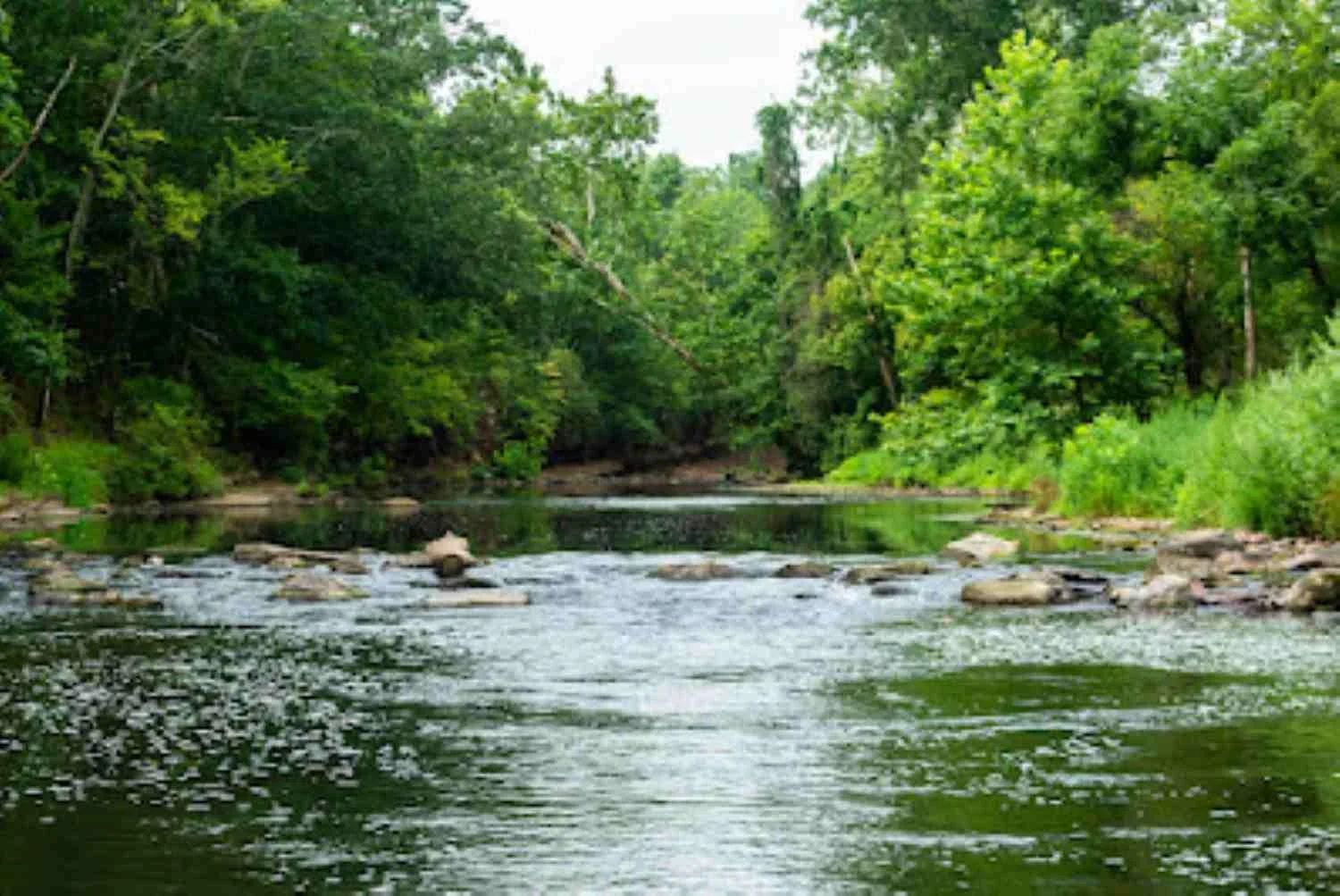
The hole dug out by TroutScapes River Restoration LLC on the Lamington River at Cowperthwaite Road. Some early September scenes show no change in color at all.
Cooling Water
Often, three or four includes a big one on the line that doesn’t get caught. A really heavy, hard-fighting fish of better than three pounds will let you know “they’re there,” even if it doesn’t get caught. In early September, the rivers begin to cool, and by late September they’ve transitioned into a fall phase. You can still wet wade, but the water can have a powerful bite. I’ve wet waded mid-October, a day or two before trout got stocked, in water so cold my legs got numb in seconds.
September is a more confident phase than October. In recent years I’ve fished the South Branch for bass during both months, and I caught a South Branch smallmouth in November, at dawn when a heavy frost crunched under the boots of a friend and I while accessing the river. On a warm day in early November many decades ago, J. B. Kasper of the Fisherman fame—he wasn’t famous yet—and I fished Stony Brook in Princeton, and as I recall that late afternoon, we each made a double figure catch. November. I do remember him say, “It’s like taking candy from a baby,” because interesting turns of phrase always caught my attention. That was the day I introduced him to Stony Brook smallmouths.
Although special challenges like wading for river smallies in temperatures below freezing can deeply satisfy curiosity if successful, such circumstances aren’t regularly productive and don’t compel much repeated interest. I thought I’d mention it because crazy attempts can sometimes pay off. I tried it once with nightcrawlers and caught a sucker. Nowadays, I fish the fall-stocked trout.
Warmth impresses me as the single most important factor of bass fishing. I know of a former reservoir fisherman who put together catches of four or five big bass in the middle of the winter, so long as the reservoir wasn’t frozen over. Even if four or five was really the exceptional catch for him—I’m sure it was—it leaves us no doubt that open water bass fishing is a year-round affair. But probably any of us, when caught in the doldrums of winter, looks forward to May as the certainty of the warmwater season, when we can fish with the confidence in bass we can depend on as active.
I’ll digress a little to talk about cold water. I like to think that May is to September as April is to October. I’ve done well on both South Branch and North Branch Raritan after leaves have changed color (and it’s a good idea to wear chest waders), but I’ve also got skunked on an occasion or two in fairly recent years. Once in October the South Branch was crystal clear. Water clarity like that can get me excited, because too many times I find the water slightly off color. Water gets released into the South Branch from Spruce Run Reservoir and seems to have a tendency to stir up sediment just enough to make the river less fishable. On the other hand, the clarity I witnessed on this day was more like that of a spring creek than a small river. But temperatures never got out of the low 50’s, and the sense I had of that water was not that of actively feeding bass but a shutdown. My friend Pat and I caught nothing and never had a fish on that late afternoon and evening.
Regarding warmth or the lack of it, that day distinctly impressed me for the lack. September may confront you with some fairly cool weather, and rarely frost late in the month, but as I’ve been leading the discussion to a conclusion about the effect of temperature, the sudden loss of bathwater warmth early in the month is a welcome feeling that lasts to the month’s end. You can’t avoid the sensation of September refreshment if you’ve been wading a river all summer, as I used to do not many years ago.
Bass get frisky. The summer months, on the other hand, invite the slowness of Senkos and sometimes the tease of topwaters, but in September, I find river bass like a Rapala floater or other jerkbait. A moderate retrieve speed while jerking the rod tip provokes punches that might rattle your thumb. Might not in October, but you can depend on a shakedown in September. Why not break it up with a bucket of killies, if you do any fluke fishing with them just before the fluke season ends?
If you’re like most of us and can’t get out to fish as often as some do, September is a good month to take advantage of a little of your time before the year’s over. Killies are fun. They’re not the only way, but why throw your bait away? If not, jerkbaits and jigs will work. So will shiners, if live bait really is your preference.
The original of this article appeared in New Jersey Federated Sportsmen’s News.